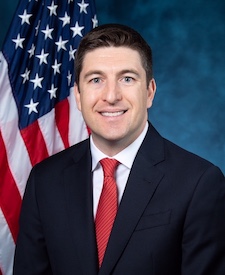
Photo of Bryan Steil
R United States House · District 1 · Wisconsin On the 2026 ballot

Rep. Bryan Steil

Compare
Total votes
2,818
all sessions
Attendance
100%
13 missed
Higher than 80% of chamber peers
With party
97%
of cast votes
Higher than 85% of chamber peers
Bipartisan score
2%
crosses aisle rarely
Lower than 86% of chamber peers
Sponsored
560
bills & resolutions
Lower than 86% of chamber peers
Committees
6
assignments
560 bills and resolutions

Sponsored bills

Total
560
Primary
83
Co-sponsor
477
This page
560
matching current filters
Co-sponsor HR 7495
In committee · Illinois House · Co-sponsor
To authorize the establishment of memorials to the Wisconsin infantry officers and enlisted men who fought in the Battle of Antietam and the Second Battle of Bull Run, and for other purposes.

Maddy summaryThis bill authorizes the establishment of two memorials honoring Wisconsin infantry regiments at Civil War battle sites. It directs the Secretary of the Interior to approve locations within Antietam National Battlefield for regiments that fought at Antietam (1862) and within Manassas National Battlefield Park for regiments that fought at the Second Battle of Bull Run (1862). The memorials must be funded and built by private entities - no federal funds may be used for design, acquisition, site preparation, or installation - and the National Park Service will assume maintenance responsibility after installation.

In committee Sep 10, 2026 1 co-sponsor
Co-sponsor HR 10257
In committee · Illinois House · Co-sponsor
To require the United States Postal Service to designate ZIP Codes for certain communities.

Maddy summaryThis bill requires the United States Postal Service to assign a single, unique ZIP Code to each of 80 specific communities across various states within one year of enactment. The legislation directly affects residents and businesses in these listed areas by ensuring they have their own distinct postal identifier rather than sharing codes with neighboring regions. The primary mechanism is a mandatory directive for the USPS to update its coding system to reflect these individual community boundaries.

In committee Sep 3, 2026 1 co-sponsor
Primary HR 9330
In committee · Illinois House · Lead sponsor
Earned Wage Access Consumer Protection Act

Maddy summaryThis bill establishes federal rules to protect workers who use earned wage access services, which allow employees to receive a portion of their pay before their regular paycheck date. It requires providers to always offer a free option for accessing wages alongside any paid options and mandates clear, upfront disclosures about fees, access limits, and the voluntary nature of any tips. The legislation also prohibits providers from sharing fees with employers, using debt collection tactics to recover unpaid amounts, or discriminating against consumers based on protected characteristics. Additionally, the bill prevents providers from treating these services as credit or loans under federal law and gives the Consumer Financial Protection Bureau authority to create specific regulations within 180 days of enactment.

In committee Sep 1, 2026 0 co-sponsors
Co-sponsor HR 6832
In committee · Illinois House · Co-sponsor
PACK Act

Maddy summaryThe Packaging and Claims Knowledge Act of 2025 requires companies to ensure that recyclable, compostable, and reusable claims on consumer product packaging are accurate and supported by third-party certification. The bill mandates that recyclable claims must include information about local recycling availability, while compostable claims must be backed by scientific evidence and clearly explain disposal limitations. Companies must also provide actual reuse systems or products for reusable packaging claims, and the Federal Trade Commission will issue guidance on compliance without creating binding regulations.

In committee Sep 1, 2026 1 co-sponsor
Co-sponsor HR 10184
In committee · Illinois House · Co-sponsor
Consumer Financial Protection Accountability and Reform Act of 2026

Maddy summaryThe Consumer Financial Protection Accountability and Reform Act of 2026 significantly restructures the Bureau of Consumer Financial Protection by subjecting it to the regular federal appropriations process and establishing an independent Inspector General appointed by the President. The bill restricts the Bureau's supervisory authority over banks and credit unions with assets under $30 billion, allowing these institutions to elect to remain under their existing prudential regulators instead. It also introduces a safe harbor for small-dollar loans of $3,500 or less that meet specific structural requirements, shielding compliant lenders from civil money penalties and private damages. Additionally, the legislation creates federal standards for earned wage access services, requiring providers to offer a no-cost option for early wage access and prohibiting them from treating these services as credit or debt under federal law.

In committee Aug 31, 2026 1 co-sponsor
Co-sponsor HR 3633
Passed · Illinois House · Co-sponsor
Digital Asset Market Clarity Act

Maddy summary# Summary of Digital Commodities and Blockchain Technology Regulatory Framework This comprehensive legislation establishes a new regulatory framework specifically for digital commodities and blockchain technology, creating a balanced approach that protects investors while fostering innovation. ## Key Components 1. **New Regulatory Structure**: - Creates new categories for digital commodity exchanges, brokers, and dealers under the Commodity Futures Trading Commission (CFTC) - Establishes "qualified digital asset custodians" as a new regulatory category - Defines "mature blockchain systems" with special regulatory treatment 2. **Core Requirements**: - Mandates segregation of customer assets and strict custody requirements - Requires robust risk management systems - Sets capital requirements for digital commodity brokers and dealers - Establishes new disclosure and reporting obligations - Defines "blockchain control persons" with special restrictions on selling digital commodities 3. **Innovation-Focused Provisions**: - Creates a "Strategic Hub for Innovation and Financial Technology" (FinHub) at the SEC - Establishes "LabCFTC" as a dedicated innovation lab within the CFTC - Provides exemptions for SEC-registered entities from certain CFTC requirements - Includes provisions for expedited hiring of digital commodities experts 4. **Studies and Research**: - Mandates studies on decentralized finance (DeFi) - Requires a study on non-fungible tokens (NFTs) - Directs a study on financial literacy among digital commodity holders - Requires a study on tokenized securities and derivatives 5. **Exclusions**: - Excludes decentralized finance activities from regulation - Excludes certain blockchain-related activities from regulatory requirements The legislation aims to create a functional regulatory framework that acknowledges the unique benefits and risks of digital commodities while ensuring investor protection, preventing market manipulation, and promoting the responsible development of this emerging technology within the United States. It seeks to prevent the shift of digital commodity development to less regulated countries by establishing a clear, balanced regulatory path.

Passed Aug 8, 2026 1 co-sponsor
Primary HR 7008
Passed · Illinois House · Lead sponsor
Stop Insider Trading Act

Maddy summaryHR 7008, the Stop Insider Trading Act, restricts Members of Congress, their spouses, and dependent children from purchasing certain investments like stocks in publicly traded companies. It requires 7-14 days' advance public notice before selling any such investment, including the sale date, description, and number of shares. Exceptions apply for work-related transactions (e.g., employer compensation) and reinvesting dividends. Violations trigger a fee of $2,000 or 10% of the investment’s value (whichever is greater), plus any net gain, paid from personal funds - not congressional allowances or campaign donations. The bill aims to prevent conflicts of interest by increasing transparency around congressional financial dealings.

Passed Aug 6, 2026 0 co-sponsors
Co-sponsor HR 5831
Passed · Illinois House · Co-sponsor
To designate the facility of the United States Postal Service located at 306 South Main Street in Waupaca, Wisconsin, as the Master Sergeant Melvin O. Handrich Post Office Building.

Maddy summaryHR 5831 designates the U.S. Postal Service facility at 306 South Main Street in Waupaca, Wisconsin, as the "Master Sergeant Melvin O. Handrich Post Office Building." The bill updates all official federal references - such as laws, maps, and documents - to use this new name for the building. It does not create new policies or affect services, but formally changes the facility's official designation. The bill directly impacts how the building is identified in all federal communications and records.

Passed Aug 6, 2026 1 co-sponsor
Co-sponsor HR 6955
Passed · Illinois House · Co-sponsor
Main Street Capital Access Act

Maddy summaryThe Main Street Capital Access Act reduces regulatory burdens for smaller banks, particularly those with less than $10 billion in assets. Key provisions include a 3-year phase-in period for new banks to meet capital requirements, lower leverage ratio requirements for rural banks (7.5% for the first 2 years), and a 30-day review process for business plan deviations. The bill also establishes an Office of Independent Examination Review, sets specific timelines for examinations (270 days) and reports (90 days), and creates a "least cost exception" for bank resolutions to prevent excessive concentration of the banking system. These changes aim to promote new bank formation, improve regulatory efficiency, and support community banking while maintaining financial stability.

Passed Jul 22, 2026 1 co-sponsor
Co-sponsor HR 1266
In committee · Illinois House · Co-sponsor
Combating Illicit Xylazine Act

Maddy summaryHR 1266, the Combating Illicit Xylazine Act, adds xylazine - a veterinary sedative increasingly found in illicit drug mixtures - to Schedule III of the Controlled Substances Act, regulating its use and trafficking. It directly affects veterinarians, animal owners, and manufacturers by allowing xylazine to be legally dispensed for animal use under specific veterinary prescriptions, while prohibiting non-veterinary human use. The bill includes transition periods (60 days for practitioners, 1 year for labeling) to ease compliance for manufacturers and practitioners, and requires the DEA and FDA to expedite necessary applications. It also mandates two congressional reports on xylazine's illicit use and trafficking patterns, and directs the Sentencing Commission to review penalties for offenses involving xylazine.

In committee Jul 21, 2026 1 co-sponsor
Showing 1 to 10 of 560 bills
1 2 3 56 Next