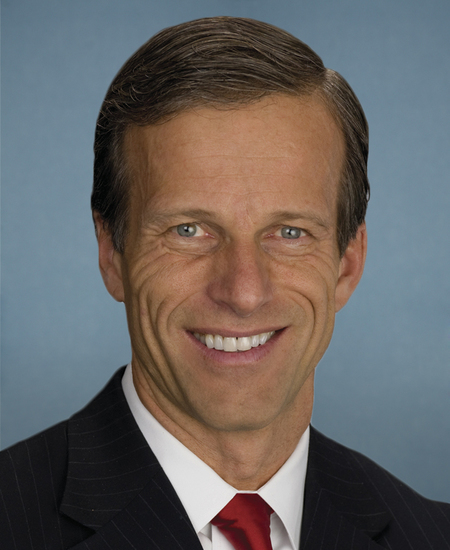
Maddy summaryThis resolution formally honors the life, service, and legacy of Jon Llewellyn Kyl, a former U.S. Senator from Arizona who passed away at age 84. It details his career highlights, including his time in the House of Representatives, his long tenure in the Senate, and his work on issues such as water policy, national security, and crime victims' rights. The bill directs the Secretary of the Senate to share this tribute with the House of Representatives and Kyl's family, while also ordering the Senate to adjourn for the day as a mark of respect.

Sponsored bills
Maddy summaryThis bill authorizes a feasibility study to assess constructing a regional water supply project for municipal, rural, and industrial use across South Dakota, Iowa, Nebraska, and Minnesota. The study, to be conducted by the Secretary of the Interior in partnership with the Dakota Mainstem Regional Water System, must follow federal reclamation standards and is limited to a $10 million federal cost (capping at 50% of total study expenses). The study must be completed within 10 years of the bill's enactment. It directly affects communities in the four specified states that could potentially benefit from the project if the study concludes it is feasible.
Maddy summaryThis bill authorizes a feasibility study to assess expanding the Lewis & Clark Regional Water System, which serves communities in Iowa, Minnesota, and South Dakota. The Secretary of the Interior must coordinate with the water system's nonprofit operator to evaluate the project's viability, including cost-sharing (requiring at least 25% non-Federal contribution for construction) and financial feasibility. The study will produce a report for Congress and the public, with the federal government covering up to 50% of the study costs ($10 million authorized). The bill does not fund construction but sets the process for determining whether expansion should proceed. The study authorization expires 10 years after enactment.
Maddy summaryThis bill directs the U.S. Secretary of the Interior to conduct a feasibility study for a proposed water supply project in Western South Dakota, which would deliver municipal, rural, and industrial water from the Missouri River. The study, to be carried out with a Western South Dakota nonprofit water system (Western Dakota Regional Water System, Inc.), must evaluate project viability, recommend whether construction should proceed, and determine the non-Federal cost share (minimum 25%). It requires the Secretary to submit a report to Congress and the public, including cost analyses based on local financial capacity. The study is authorized with $10 million in federal funding, capped at 50% of costs, and expires 10 years after enactment.
Maddy summaryThe Pennington County Land Conveyance Act directs the transfer of approximately 8.97 acres of federal land from the Black Hills National Forest to Pennington County, South Dakota. This transfer is made without payment and includes any existing improvements on the property. Upon completion, the boundary of the national forest will be adjusted to reflect the change in ownership. The county is authorized to use the land for a public works facility or other necessary purposes determined by local officials.
Maddy summaryThis resolution authorizes employees of Senator Elizabeth Warren's office to provide testimony in a criminal threat investigation by the U.S. Attorney for the District of Massachusetts. It directs the Senate Legal Counsel to represent these employees regarding the production of testimony and documents related to their official duties. The measure relies on existing Senate rules and the Ethics in Government Act to permit the release of evidence while allowing the Senate to assert privileges where appropriate.
Maddy summaryThis resolution authorizes the Senate Legal Counsel to represent Senators Marsha Blackburn and Ben Ray Luján in a federal lawsuit involving the Federal Trade Commission. The legal action stems from subpoenas issued by defendants in the case requesting documents related to the senators' official duties. By invoking specific provisions of the Ethics in Government Act and Senate rules, the resolution ensures that the Senate’s legal team handles these requests on behalf of the affected members.
Maddy summaryThe Kids Online Safety Act (S 1748) requires major social media platforms, online video games, and other "covered platforms" to implement specific safety features for minors (under 17). These features include default privacy settings that limit harmful design features like infinite scrolling and auto-play, parental controls for managing minors' accounts, and restrictions on advertising illegal products to minors. The bill also mandates annual transparency reports about how platforms are used by minors and requires platforms to provide clear notices about their content algorithms. It creates a Kids Online Safety Council to advise Congress on online safety issues for children. The law applies to platforms with more than 10 million monthly users in the U.S. and takes effect 18 months after enactment.
Maddy summaryThis legislative resolution authorizes the U.S. Senate to consider a large list of federal nominations together in a single executive session rather than voting on each one individually. The measure directly affects the confirmation process for dozens of candidates seeking roles as ambassadors, United States attorneys, marshals, and various cabinet-level or agency officials. By grouping these nominations, the resolution streamlines the Senate's workflow to allow for a more efficient review of appointments across the State Department, Department of Justice, and other federal agencies.
Maddy summaryThis bill amends a technical definition in grazing regulations to replace "lands within National Forests" with "National Forest System land" as defined in another law. It does not change existing grazing rules or directly affect any specific groups, as it only updates terminology for administrative consistency. The amendment explicitly states it won't alter other provisions governing national grasslands grazing under existing laws like the Federal Land Policy and Management Act or the Public Rangelands Improvement Act. This is a procedural clarification with no new policy changes or impacts on livestock operators or land management practices.