

AN ACT CONCERNING A STUDY OF TRIPLE BOTTOM LINE JUSTICE.
HB 5241 establishes a pilot program in a city with over 148,000 residents to test a "Triple Bottom Line Justice" approach, which integrates environmental cleanup, health equity, and community engagement. The program requires state health and environmental agencies to partner with a local community organization to use ICD-10 Z codes (which track social and environmental health factors) in healthcare billing, aiming for 20% adoption by 2030. It mandates annual reports on progress, develops educational materials for healthcare providers on these codes, and evaluates how transforming polluted sites ("Brownfields to Healthfields") can reduce long-term health costs. The pilot must conclude by January 2028 with a final report to the legislature.
Bill status
signed
all 5 stages cleared
Introduction
Feb 2026
Committee Review
Apr 2026
House Passage
May 2026
Senate Passage
May 2026
Signed into Law
Jun 2026
Introduced Feb 18, 2026
Signed Jun 4, 2026
Maddy AI version diff · 1 comparison
What changed between versions
Raised Bill
→
APP Joint Favorable Substitute
·
4 edits
MODERATE
The bill was revised from a 'Raised Bill' to a 'Joint Favorable Substitute,' incorporating specific edits to the definitions and program goals. The most significant change is the removal of a requirement to use ICD-10 Z codes to track social determinants of health, which was replaced by a focus on 'Brownfields to Healthfields' initiatives. Additionally, the language regarding collaboration between state officials was updated from 'consultation' to 'collaboration,' and the definition of 'Brownfields to Healthfields' was expanded to explicitly include strengthening physical and mental health.
Scope change
The bill's scope shifted from a broad pilot program involving environmental remediation and health code tracking to a more focused demonstration of community-led brownfield redevelopment. The requirement to track social determinants of health via specific diagnostic codes was removed.
DEFINITION
The definition of 'Brownfields to Healthfields' was updated to explicitly state that the methodology strengthens 'physical and mental health,' in addition to resiliency, equity, and vitality.
REQUIREMENT
The requirement to establish a pilot program was changed from 'consultation' with the Commissioner of Energy and Environmental Protection to 'collaboration' with that commissioner.
The definition and specific goal of using 'ICD-10 Z codes' to track social, economic, and environmental determinants of health were removed from the bill.
The program goals were revised to remove the objective of generating educational curriculum based on environmental remediation outcomes and the goal of increasing the utilization rate of ICD-10 Z codes.
Floor votes · Senate May 6, 2026 · House May 4, 2026
How they voted
33–0
Passed · 3 other
Total votes 36
May 6, 2026
D
Democratic25
88% Yea
R
Republican11
100% Yea
Vote distribution
All Yea
All Nay
Mixed
No data
Full legislative history
Actions timeline
Total actions
31
Key actions
9
Committee
4
Amendments
2
Jun 4, 2026
Signed into law
SIGNED BY GOVERNOR
lower
May 6, 2026
Senate · Passed
Senate Vote: pass (33-0-3)
senate
May 5, 2026
Upper · Passed
SEN. PASSED, HO. AMEND. SCH. A
upper
May 5, 2026
Upper · Passed
SEN. ADOPTED HO. AMEND. SCH. A
upper
May 4, 2026
Lower · Passed
HOUSE PASSED, HOUSE AMEND. SCH. A
lower
May 4, 2026
Lower · Passed
HOUSE ADOPTED HOUSE AMEND. SCH. A
lower
Apr 13, 2026
Lower · Passed
Joint Favorable Substitute
lower
Apr 7, 2026
Lower · Passed
REF. BY HOUSE TO COMMITTEE ON Appropriations
lower
Mar 9, 2026
Lower · Passed
Joint Favorable
lower
Feb 18, 2026
Committee
REF. TO JOINT COMM. ON Public Health
lower
3 primary · 0 co-sponsors
Sponsors
Role
Legislator
Party
State
District
P

Andre Baker
DDemocratic
P

Nick Gauthier
DDemocratic
P
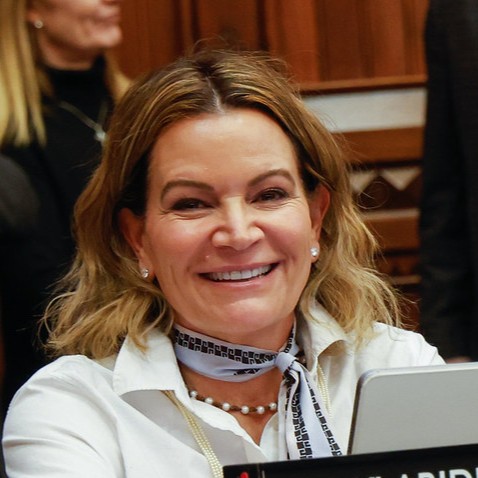
Nicole Klarides-Ditria
RRepublican
Ask Maddy
·
AI policy assistant
Ask Maddy about HB 5241
Scope: CT
Hi! I can help you understand HB 5241. What would you like to know?
Try one of these
i
Maddy answers using official bill text and legislative records. Always verify before sharing.
Sources cited inline