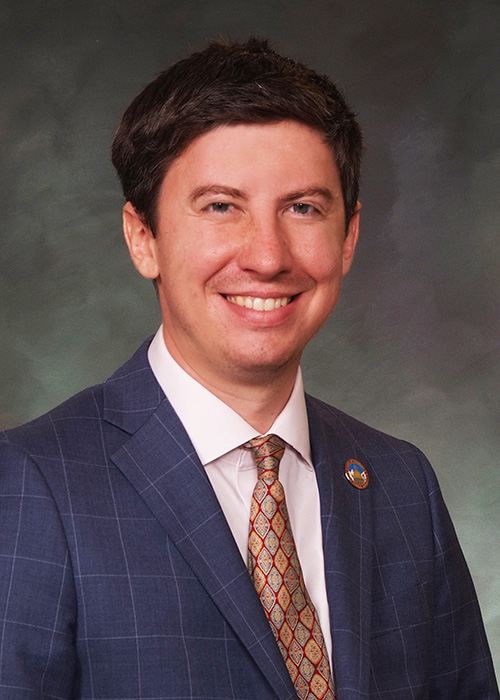
Photo of William Lindstedt
D Colorado Senate · District 25 On the 2026 ballot

Sen. William Lindstedt

Compare
Total votes
3,111
all sessions
Attendance
92%
264 missed
Near the chamber average
With party
98%
of cast votes
Near the chamber average
Bipartisan score
2%
crosses aisle rarely
Near the chamber average
Sponsored
396
bills & resolutions
Near the chamber average
Committees
5
assignments
396 bills and resolutions

Sponsored bills

Total
396
Primary
86
Co-sponsor
310
This page
396
matching current filters
Co-sponsor HB 1428
Signed into law · Colorado House · Co-sponsor
Administration of Publicly Funded Education Programs

The act requires the department of education (department) to submit a report to the joint budget committee regarding part-time enrichment programs and single- and multi-district online education programs, including online schools, online programs, and supplemental online courses offered by in-person schools.     The act authorizes the department to extend the authorization for the board of cooperative services that is currently administering the statewide supplemental online and blended learning program for up to 2 additional years prior to initiating a new 5-year designation.(Note: This summary applies to this bill as enacted.)

Signed into law Jun 4, 2026 1 co-sponsor
Primary HB 1430
Signed into law · Colorado House · Lead sponsor
Transportation Funding Adjustments

Contingent upon voter approval at the November 2026 general election of a proposed initiative to amend the state constitution to change existing law on transportation funding and to increase the amount of state revenue dedicated to road transportation (proposed initiative), from January 1, 2027, through July 1, 2030, the act reduces:The excise tax on gasoline from $0.22 per gallon to $0.14 per gallon;The excise tax on special fuel from $0.205 per gallon to $0.13 per gallon; Certain vehicle registration fees, including late fees; andThe road usage fees from $0.06 per gallon to $0.04 per gallon and then, beginning in state fiscal year 2027-28, as necessary to offset the amount of state revenue diverted to transportation uses as the result of the proposed initiative.     The act creates the support road transportation fund (fund) contingent upon voter approval of the proposed initiative. The fund consists of state revenue dedicated to road transportation by the proposed initiative. Money in the fund is used to replace certain transportation-related general fund transfers for payments for the financed purchase of assets or certificate of participation agreements, and to replace certain general fund transfers to the state highway fund. The money remaining in the fund after making these transfers is allocated as follows:60% is paid to the state highway fund;23% is paid to counties for certain transportation expenses; and17% is paid to cities and incorporated towns for certain transportation expenses.     The act clarifies that state revenue collected to support road transportation, as defined in the proposed initiative, does not include enterprise fee revenue.     The act creates the road enterprise to complete preventive maintenance, repair, rehabilitation, and reconstruction projects to improve the condition of the roadway surface of the state highway system. The road enterprise is authorized to impose fees for oversize and overweight vehicles and longer vehicle combinations. The creation of the road enterprise is not contingent upon voter approval of the proposed initiative.     Contingent upon the proposed initiative being withdrawn or not submitted for the November 2026 general election, the act creates the transportation funding working group to evaluate and make recommendations to the general assembly, the transportation commission, and the governor concerning funding state and local surface transportation maintenance, repair, capacity, and safety.     Lastly, the act reduces the July 1, 2026, transfer from the general fund to the state highway fund from approximately $50 million to $500,000.(Note: This summary applies to this bill as enacted.)

Signed into law Jun 4, 2026 0 co-sponsors
Co-sponsor SB 170
Signed into law · Colorado Senate · Co-sponsor
Task Force to Expand Effective Public Schools

The act creates the access to opportunity task force (task force) to study and report on how to expand access to effective public schools to address opportunity gaps.     The act requires the task force to report its findings and recommendations to the education committees of the house of representatives and the senate, the governor, the state board of education, the commissioner of education, and the department of education on or before January 1, 2027. If the first meeting of the task force is not until after July 31, 2026, then the report deadline is 5 months after the task force's first meeting.     The act specifies that the task force will only conduct a study and prepare a report if the department of education receives sufficient gifts, grants, and donations.(Note: This summary applies to this bill as enacted.)

Signed into law Jun 4, 2026 1 co-sponsor
Co-sponsor HB 1328
Signed into law · Colorado House · Co-sponsor
Medicaid Nonemergency Medical Transportation

The act requires the nonemergency medical transportation broker (broker) to establish the transportation community advisory board (TCAB) and requires the state department of health care policy and financing (state department) to collaborate with the TCAB prior to establishing rules and processes for the safety and oversight of nonmedical transportation services and nonemergency medical transportation (NEMT) services.     The act requires, in collaboration with the TCAB, certain rules for NEMT the state department must adopt. The state department may impose trip caps or market-share restrictions on a transportation provider (provider) as part of corrective action plan. The act requires providers to use vehicles equipped with 2-way video cameras and a video recording system when transporting members.     The act establishes how the broker must roll out their implementation and requires the broker to provide all providers with software, a communication toolkit, training, and technical assistance to facilitate NEMT services. The broker may encourage medicaid members (members) to book transportation services at least 2 days before their requested transportation date, and the broker shall accept and make reasonable efforts to fulfill same-day and next-day transportation requests. The act requires providers, only after all service regions have been implemented, to accommodate member requests for preferred or alternate drivers when operationally feasible.     The act requires the broker, and, if there is no broker, the providers to verify that individuals using the transportation services are eligible members during the scheduling of transportation services. The act prohibits the broker from operating, owning, or controlling a provider in Colorado. The act requires the broker to provide their trip assignment rules and procedures to the state department for approval and for publication on the state department's website. The act allows a transportation network company to provide NEMT services when a provider is unavailable.     The state department shall ensure all transportation providers, drivers, and vehicles are credentialed, and services provided by noncredentialed drivers or in noncredentialed vehicles are not eligible for reimbursement. The act prohibits the state department from denying payment of services to providers if the provider provides scheduled transportation services in good faith based on the information provided by the broker or if the provider had no knowledge of an inaccuracy and the provider followed all applicable rules and procedures. Subject to available appropriations, the act requires the state department to audit providers and audit the broker annually.     The act requires the state department to categorize all NEMT expenditures as medical services and make changes to the NEMT program as necessary to obtain medical services federal match rates for NEMT services. The act also eliminates the requirement that the state department provide transportation services as an administrative cost.     The act reduces appropriations to the state department from the general fund by $76,639 and from the healthcare affordability and sustainability hospital provider fee cash fund by $20,941,853.(Note: This summary applies to this bill as enacted.)

Signed into law Jun 4, 2026 1 co-sponsor
Co-sponsor HB 1325
Signed into law · Colorado House · Co-sponsor
Natural Medicine

The act establishes the ibogaine research pilot program (pilot program) in the behavioral health administration (BHA) to research the safety and effectiveness of using ibogaine to treat mental health conditions and substance use disorders. The act requires the BHA to establish a committee to review pilot program site applications and make recommendations to the BHA on which applicants to accept. The BHA may select up to 5 ibogaine pilot sites. The act allows the BHA to seek, accept, and expend gifts, grants, and donations and establishes the ibogaine research pilot program cash fund. The pilot program is contingent on the BHA receiving sufficient gifts, grants, and donations to administer the pilot program and award grants to the selected ibogaine pilot sites to help with financing needs.     Under current law, the division of natural medicine advisory board consists of 15 voting members, 8 of whom must have general expertise and experience related to natural medicine and 7 of whom must have specialized expertise and experience in various areas of natural medicine. The act amends the expertise and experience requirements to apply equally to all 15 voting members.     The act adds that a facilitator of natural medicine services is not liable for a physical or psychological injury that a participant may experience as a result of the facilitator's performance or supervision of the natural medicine services that a participant receives, unless the injury is the result of the facilitator's intentional misconduct, gross negligence, or a deviation from the recognized standard of care.     The act authorizes the state licensing authority for natural medicine or natural medicine product (state licensing authority) to adopt rules related to the administration, manufacturing, and use of ibogaine.     The act sets requirements for how the state licensing authority must prioritize reviewing applications for licensure to facilitate natural medicine services and allows the state licensing authority to set different licensing fees depending on the type of natural medicine the applicant is seeking licensure for.     The act allows the state licensing authority to accept gifts, grants, and donations from public or private sources and requires gifts, grants, or donations received to be deposited in the regulated natural medicine division cash fund.     The act requires the BHA to work to secure federal research and development funding available through the advanced research projects agency for health within the federal department of health and human services, or other available funding, in order to advance research on the use of ibogaine for the treatment of serious mental illness.     The act updates the powers and duties of the director of the division of professions and occupations to include adopting rules that guide the use and administration of ibogaine.     A licensee seeking to cultivate, manufacture, dispense, or administer ibogaine shall, in consultation with Indigenous communities, establish a benefit-sharing plan that directly benefits those Indigenous communities.     The act:Updates definition of 'administration session' to include the use of regulated natural medicine and regulated natural medicine product that the participant purchases to consume during the administration session;Prohibits a person from advertising bona fide harm reduction services or bona fide support services offered for remuneration, advertising natural medicine or natural medicine products, or using harm reduction services or support services to conduct sales of natural medicine;Clarifies that the state licensing authority is not required to conduct routine, periodic, or pre-operational inspections as a condition of licensure unless expressly required;Requires state licensing authority to adopt rules regarding licensing privileges and restrictions of a limited regulated natural medicine sales license and eligibility requirements for an applicant to obtain a limited regulated natural medicine sales license;Allows the state licensing authority to adopt rules regarding the application procedures and license requirement for a healing center to operate a temporary premises; and requirements for cultivation, manufacture, testing, or dispensing of ibogaine;Allows the department of public health and environment to issue a temporary premises permit to a licensed natural medicine healing center if certain conditions are met and allows a healing center to apply for a temporary premises permit;Prohibits a healing center licensee from selling regulated natural medicine or regulated natural medicine product unless a co-located limited regulated natural medicine sales licensee conducts the transaction in accordance with certain requirements; andAllows the director of the natural medicine division to issue an order to cease and desist if the director determines that a person is acting or has acted without a license to operate a natural medicine business or to own, grow, harvest, transfer, manufacture, supervise, provide, or administer natural medicine.(Note: This summary applies to this bill as enacted.)

Signed into law Jun 4, 2026 1 co-sponsor
Co-sponsor HB 1207
Signed into law · Colorado House · Co-sponsor
Disclosure of Demographic Workforce Data

The act requires, beginning July 1, 2027, a private entity conducting business in the state that employs 100 or more workers (employer) to include demographic workforce data collected through the United States equal employment opportunity commission's 'Employer Information Report' (EEO-1 data) in periodic reports to the secretary of state. An employer is required to provide the EEO-1 data to the secretary of state even if the federal government repeals or discontinues the federal requirement to submit the EEO-1 data to the United States equal employment opportunity commission.(Note: This summary applies to this bill as enacted.)
Signed into law Jun 4, 2026 1 co-sponsor
Co-sponsor HB 1276
Signed into law · Colorado House · Co-sponsor
Protect Safety of Individuals Who Are Immigrants

The act exempts Colorado courts' e-filing system from the requirement that users certify that they will not disclose personal identifying information obtained from the system for federal immigration enforcement.     The act authorizes a public health agency to inspect or examine a facility that houses or detains individuals who are noncitizens for purposes of civil immigration proceedings.     Under current law, the department of public health and environment is authorized to inspect facilities that house or detain individuals who are noncitizens for purposes of civil immigration proceedings. The act expands the inspection authority, including the frequency of inspections and things that are subject to inspection. A facility that refuses to allow the inspection is subject to a civil penalty. The department of public health and environment is authorized to set fees for inspections and deposit the money from the fees in the immigration facility inspection and detention cash fund, which is created in the state treasury.     The act authorizes the department of public health and environment to require facilities that house or detain individuals who are noncitizens for purposes of civil immigration proceedings to comply with requirements, including health and safety standards and reporting requirements. A facility that fails to comply is subject to a civil penalty. The act requires the department of public health and environment to submit an annual report to the attorney general concerning facilities' compliance with these new requirements and make the report publicly available on its website.     The act requires the P.O.S.T. board to establish training standards related to peace officer compliance with current laws concerning civil immigration detainers. P.O.S.T.-certified peace officers must complete the training before December 31, 2027.     The act requires the attorney general to develop and make publicly available a policy regarding current laws concerning the protection of personal identifying information.     The act appropriates $107,283 to the department of public health and environment from the immigration facility inspection and detention cash fund.(Note: This summary applies to this bill as enacted.)

Signed into law Jun 4, 2026 1 co-sponsor
Co-sponsor HB 1298
Signed into law · Colorado House · Co-sponsor
Background Checks for Child Welfare Placements

The act gives county departments of human or social services and the Colorado department of human services (department) the statutory authority needed to conduct the required fingerprint-based criminal history record checks for individuals who provide out-of-home care for child-welfare-involved youth in accordance with the federal bureau of investigation's standards.     For the 2026-27 state fiscal year, the general assembly anticipates that the department will receive $350,000 in federal funds to implement the act, and $350,000 is appropriated to the office of the governor for use by the office of information technology to implement the act. The $350,000 appropriation is from reappropriated funds received from the department.(Note: This summary applies to this bill as enacted.)

Signed into law Jun 4, 2026 1 co-sponsor
Co-sponsor SB 80
Signed into law · Colorado Senate · Co-sponsor
Cradle to Career Grant Program Creation

The act creates the cradle to career grant program (grant program) in the department of human services (CDHS) to provide grants to a local government, local education provider, state institution of higher education, Indian tribe or tribal organization, or community-based nonprofit or not-for-profit organization (eligible entity) to promote coordinated community-based supports and services that open opportunities for economic mobility from poverty. The grant program must connect children and youth with high-quality educational and extracurricular programming and families with key health and social services in order to improve prenatal and early childhood outcomes, student achievement, workforce readiness, and wealth-building opportunities.     The act creates the cradle to career advisory council (council) to approve or disapprove CDHS's potential grant recipients and to collaborate with CDHS to develop grant program guidelines and criteria for awarding grants. Council members must be Colorado residents and must not provide financial support for the grant program.     To receive a grant, an eligible entity must submit an application that includes an economic mobility needs assessment and a comprehensive proposal to address the needs within its designated service area. The application must identify prospective community partners and subcontractors. The act caps the amount that CDHS may award in connection with a single grant application at 49% of available grant program money.     A grant recipient must comply with various health and safety, financial responsibility, and anti-discrimination safeguards. Each grant recipient must annually report to CDHS addressing the recipient's progress using a set of performance indicators to assess the economic mobility outcomes and impacts associated with the grant award. CDHS must make a related report to the health and human services committees of the general assembly and the governor each year.     CDHS may seek, accept, and expend gifts, grants, and donations for grant-program-related purposes. If CDHS does not receive $900,000 for those purposes on or before December 31, 2028, the grant program is repealed. The general assembly shall not appropriate general fund dollars for grant program operations.(Note: This summary applies to this bill as enacted.)

Signed into law Jun 4, 2026 1 co-sponsor
Co-sponsor SB 132
Signed into law · Colorado Senate · Co-sponsor
Voluntary Alcohol Breath Test

Maddy summarySB 132, known as the "Magnus Law," requires Colorado law enforcement officers to offer drivers involved in collisions resulting in death or suspected serious injury the opportunity to voluntarily take a breath test for alcohol. The bill mandates officers provide clear, plain-language advisement that the test is voluntary, refusal carries no penalty, and results cannot be used in court. It applies when officers reasonably suspect the driver was at fault and the driver isn't critically injured, creating a standardized protocol to ensure consistent investigation of potential impairment at serious crash scenes. This change aims to preserve evidence that might otherwise be lost, without altering existing legal standards for driving under the influence.

Signed into law Jun 4, 2026 1 co-sponsor
Showing 1 to 10 of 396 bills
1 2 3 40 Next