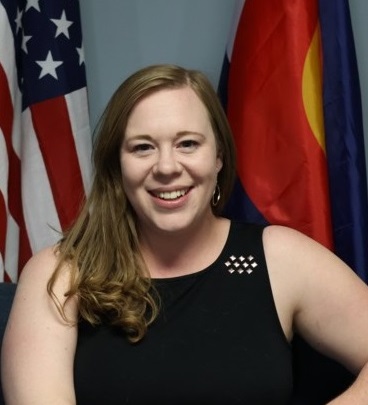
Photo of Katie Wallace
D Colorado Senate · District 17 On the 2026 ballot

Sen. Katie Wallace

Compare
Total votes
864
all sessions
Attendance
63%
412 missed
Near the chamber average
With party
99%
of cast votes
Near the chamber average
Bipartisan score
1%
crosses aisle rarely
Near the chamber average
Sponsored
490
bills & resolutions
Higher than 86% of chamber peers
Committees
2
assignments
490 bills and resolutions

Sponsored bills

Total
490
Primary
55
Co-sponsor
435
This page
490
matching current filters
Co-sponsor HB 1428
Signed into law · Colorado House · Co-sponsor
Administration of Publicly Funded Education Programs

The act requires the department of education (department) to submit a report to the joint budget committee regarding part-time enrichment programs and single- and multi-district online education programs, including online schools, online programs, and supplemental online courses offered by in-person schools.     The act authorizes the department to extend the authorization for the board of cooperative services that is currently administering the statewide supplemental online and blended learning program for up to 2 additional years prior to initiating a new 5-year designation.(Note: This summary applies to this bill as enacted.)

Signed into law Jun 4, 2026 1 co-sponsor
Co-sponsor HB 1431
Signed into law · Colorado House · Co-sponsor
Competency for Occupational Licensure Portability

Under existing law, an individual licensed, certified, registered, or enrolled in good standing to practice a particular profession or occupation in another state or United States territory or through the federal government is eligible to apply for and receive a license, certification, registration, or enrollment in that profession or occupation in Colorado (accreditation) if the individual meets specific criteria. The act adds an individual licensed, certified, registered, or enrolled in good standing to practice a particular profession or occupation in another country to those individuals eligible for accreditation if the individual meets specific criteria.(Note: This summary applies to this bill as enacted.)

Signed into law Jun 4, 2026 1 co-sponsor
Co-sponsor HB 1430
Signed into law · Colorado House · Co-sponsor
Transportation Funding Adjustments

Contingent upon voter approval at the November 2026 general election of a proposed initiative to amend the state constitution to change existing law on transportation funding and to increase the amount of state revenue dedicated to road transportation (proposed initiative), from January 1, 2027, through July 1, 2030, the act reduces:The excise tax on gasoline from $0.22 per gallon to $0.14 per gallon;The excise tax on special fuel from $0.205 per gallon to $0.13 per gallon; Certain vehicle registration fees, including late fees; andThe road usage fees from $0.06 per gallon to $0.04 per gallon and then, beginning in state fiscal year 2027-28, as necessary to offset the amount of state revenue diverted to transportation uses as the result of the proposed initiative.     The act creates the support road transportation fund (fund) contingent upon voter approval of the proposed initiative. The fund consists of state revenue dedicated to road transportation by the proposed initiative. Money in the fund is used to replace certain transportation-related general fund transfers for payments for the financed purchase of assets or certificate of participation agreements, and to replace certain general fund transfers to the state highway fund. The money remaining in the fund after making these transfers is allocated as follows:60% is paid to the state highway fund;23% is paid to counties for certain transportation expenses; and17% is paid to cities and incorporated towns for certain transportation expenses.     The act clarifies that state revenue collected to support road transportation, as defined in the proposed initiative, does not include enterprise fee revenue.     The act creates the road enterprise to complete preventive maintenance, repair, rehabilitation, and reconstruction projects to improve the condition of the roadway surface of the state highway system. The road enterprise is authorized to impose fees for oversize and overweight vehicles and longer vehicle combinations. The creation of the road enterprise is not contingent upon voter approval of the proposed initiative.     Contingent upon the proposed initiative being withdrawn or not submitted for the November 2026 general election, the act creates the transportation funding working group to evaluate and make recommendations to the general assembly, the transportation commission, and the governor concerning funding state and local surface transportation maintenance, repair, capacity, and safety.     Lastly, the act reduces the July 1, 2026, transfer from the general fund to the state highway fund from approximately $50 million to $500,000.(Note: This summary applies to this bill as enacted.)

Signed into law Jun 4, 2026 1 co-sponsor
Co-sponsor HB 1328
Signed into law · Colorado House · Co-sponsor
Medicaid Nonemergency Medical Transportation

The act requires the nonemergency medical transportation broker (broker) to establish the transportation community advisory board (TCAB) and requires the state department of health care policy and financing (state department) to collaborate with the TCAB prior to establishing rules and processes for the safety and oversight of nonmedical transportation services and nonemergency medical transportation (NEMT) services.     The act requires, in collaboration with the TCAB, certain rules for NEMT the state department must adopt. The state department may impose trip caps or market-share restrictions on a transportation provider (provider) as part of corrective action plan. The act requires providers to use vehicles equipped with 2-way video cameras and a video recording system when transporting members.     The act establishes how the broker must roll out their implementation and requires the broker to provide all providers with software, a communication toolkit, training, and technical assistance to facilitate NEMT services. The broker may encourage medicaid members (members) to book transportation services at least 2 days before their requested transportation date, and the broker shall accept and make reasonable efforts to fulfill same-day and next-day transportation requests. The act requires providers, only after all service regions have been implemented, to accommodate member requests for preferred or alternate drivers when operationally feasible.     The act requires the broker, and, if there is no broker, the providers to verify that individuals using the transportation services are eligible members during the scheduling of transportation services. The act prohibits the broker from operating, owning, or controlling a provider in Colorado. The act requires the broker to provide their trip assignment rules and procedures to the state department for approval and for publication on the state department's website. The act allows a transportation network company to provide NEMT services when a provider is unavailable.     The state department shall ensure all transportation providers, drivers, and vehicles are credentialed, and services provided by noncredentialed drivers or in noncredentialed vehicles are not eligible for reimbursement. The act prohibits the state department from denying payment of services to providers if the provider provides scheduled transportation services in good faith based on the information provided by the broker or if the provider had no knowledge of an inaccuracy and the provider followed all applicable rules and procedures. Subject to available appropriations, the act requires the state department to audit providers and audit the broker annually.     The act requires the state department to categorize all NEMT expenditures as medical services and make changes to the NEMT program as necessary to obtain medical services federal match rates for NEMT services. The act also eliminates the requirement that the state department provide transportation services as an administrative cost.     The act reduces appropriations to the state department from the general fund by $76,639 and from the healthcare affordability and sustainability hospital provider fee cash fund by $20,941,853.(Note: This summary applies to this bill as enacted.)

Signed into law Jun 4, 2026 1 co-sponsor
Co-sponsor HB 1325
Signed into law · Colorado House · Co-sponsor
Natural Medicine

The act establishes the ibogaine research pilot program (pilot program) in the behavioral health administration (BHA) to research the safety and effectiveness of using ibogaine to treat mental health conditions and substance use disorders. The act requires the BHA to establish a committee to review pilot program site applications and make recommendations to the BHA on which applicants to accept. The BHA may select up to 5 ibogaine pilot sites. The act allows the BHA to seek, accept, and expend gifts, grants, and donations and establishes the ibogaine research pilot program cash fund. The pilot program is contingent on the BHA receiving sufficient gifts, grants, and donations to administer the pilot program and award grants to the selected ibogaine pilot sites to help with financing needs.     Under current law, the division of natural medicine advisory board consists of 15 voting members, 8 of whom must have general expertise and experience related to natural medicine and 7 of whom must have specialized expertise and experience in various areas of natural medicine. The act amends the expertise and experience requirements to apply equally to all 15 voting members.     The act adds that a facilitator of natural medicine services is not liable for a physical or psychological injury that a participant may experience as a result of the facilitator's performance or supervision of the natural medicine services that a participant receives, unless the injury is the result of the facilitator's intentional misconduct, gross negligence, or a deviation from the recognized standard of care.     The act authorizes the state licensing authority for natural medicine or natural medicine product (state licensing authority) to adopt rules related to the administration, manufacturing, and use of ibogaine.     The act sets requirements for how the state licensing authority must prioritize reviewing applications for licensure to facilitate natural medicine services and allows the state licensing authority to set different licensing fees depending on the type of natural medicine the applicant is seeking licensure for.     The act allows the state licensing authority to accept gifts, grants, and donations from public or private sources and requires gifts, grants, or donations received to be deposited in the regulated natural medicine division cash fund.     The act requires the BHA to work to secure federal research and development funding available through the advanced research projects agency for health within the federal department of health and human services, or other available funding, in order to advance research on the use of ibogaine for the treatment of serious mental illness.     The act updates the powers and duties of the director of the division of professions and occupations to include adopting rules that guide the use and administration of ibogaine.     A licensee seeking to cultivate, manufacture, dispense, or administer ibogaine shall, in consultation with Indigenous communities, establish a benefit-sharing plan that directly benefits those Indigenous communities.     The act:Updates definition of 'administration session' to include the use of regulated natural medicine and regulated natural medicine product that the participant purchases to consume during the administration session;Prohibits a person from advertising bona fide harm reduction services or bona fide support services offered for remuneration, advertising natural medicine or natural medicine products, or using harm reduction services or support services to conduct sales of natural medicine;Clarifies that the state licensing authority is not required to conduct routine, periodic, or pre-operational inspections as a condition of licensure unless expressly required;Requires state licensing authority to adopt rules regarding licensing privileges and restrictions of a limited regulated natural medicine sales license and eligibility requirements for an applicant to obtain a limited regulated natural medicine sales license;Allows the state licensing authority to adopt rules regarding the application procedures and license requirement for a healing center to operate a temporary premises; and requirements for cultivation, manufacture, testing, or dispensing of ibogaine;Allows the department of public health and environment to issue a temporary premises permit to a licensed natural medicine healing center if certain conditions are met and allows a healing center to apply for a temporary premises permit;Prohibits a healing center licensee from selling regulated natural medicine or regulated natural medicine product unless a co-located limited regulated natural medicine sales licensee conducts the transaction in accordance with certain requirements; andAllows the director of the natural medicine division to issue an order to cease and desist if the director determines that a person is acting or has acted without a license to operate a natural medicine business or to own, grow, harvest, transfer, manufacture, supervise, provide, or administer natural medicine.(Note: This summary applies to this bill as enacted.)

Signed into law Jun 4, 2026 1 co-sponsor
Primary HB 1250
Signed into law · Colorado House · Lead sponsor
Procedures Related to Civil Asset Forfeiture

The act clarifies an existing requirement for the criminal conviction of a property owner by requiring that one or more criminal charges be brought as a prerequisite to any nuisance abatement or forfeiture proceeding.     Existing law provides an exception to the conviction requirement for noninnocent owners who are not subject to criminal charges that no criminal conviction is necessary of the nonowner criminal defendant if the plaintiff proves its case by clear and convincing evidence that the property subject to the forfeiture proceeding is traceable proceeds of the charged offense or related criminal activity. The act clarifies this exception to first require a conviction of the nonowner criminal defendant before the noninnocent owner's property may be forfeited, while retaining other various exceptions that allow forfeiture actions to proceed against the interest of a claimant.     The act establishes a right for indigent civil asset forfeiture defendants to access forfeiture defense counsel and creates a procedure for the appointment of forfeiture defense counsel in nuisance abatement and forfeiture proceedings. The state court administrator shall enter into a contract for services with a private contractor who regularly provides legal services for indigent clients or litigants to provide a legal defense to a civil asset forfeiture proceeding. The private contractor is subject to certain reporting requirements.     The act creates a forfeiture defense counsel fund (fund) to pay for contracted forfeiture defense counsel who are authorized to represent persons against whom a nuisance abatement or forfeiture proceeding has been filed in connection with criminal charges. The fund is capped at $500,000, and starting in state fiscal year 2027-28, no general fund money is allowed to finance the fund. The balance of the fund over $500,000 is credited to the law enforcement community services grant program fund. The act transfers any unexpended and unencumbered money from the law enforcement community services grant program fund to the forfeiture counsel defense fund.     The act alters the disposition of property and proceeds ordered forfeited in a nuisance abatement or forfeiture action. Currently, forfeited property and proceeds are applied first toward restitution and cost recovery for a list of stakeholders, and of the remainder, 50% is granted to the local governmental body with authority over the seizing agency, 25% is granted to the local behavioral health administrative services organization, and 25% is granted to the law enforcement community services grant program fund. The act amends the disposition of the remainder so that 50% is granted to the local governmental body with authority over the seizing agency, 25% is granted to the fund, and 25% is granted to the local behavioral health administrative services organization.     The act appropriates $556,750 to the judicial department from the fund for civil asset forfeiture defense contracting and $55,000 to the department of local affairs from the fund for civil asset forfeiture portal administration.(Note: This summary applies to this bill as enacted.)
Signed into law Jun 4, 2026 0 co-sponsors
Co-sponsor HB 1276
Signed into law · Colorado House · Co-sponsor
Protect Safety of Individuals Who Are Immigrants

The act exempts Colorado courts' e-filing system from the requirement that users certify that they will not disclose personal identifying information obtained from the system for federal immigration enforcement.     The act authorizes a public health agency to inspect or examine a facility that houses or detains individuals who are noncitizens for purposes of civil immigration proceedings.     Under current law, the department of public health and environment is authorized to inspect facilities that house or detain individuals who are noncitizens for purposes of civil immigration proceedings. The act expands the inspection authority, including the frequency of inspections and things that are subject to inspection. A facility that refuses to allow the inspection is subject to a civil penalty. The department of public health and environment is authorized to set fees for inspections and deposit the money from the fees in the immigration facility inspection and detention cash fund, which is created in the state treasury.     The act authorizes the department of public health and environment to require facilities that house or detain individuals who are noncitizens for purposes of civil immigration proceedings to comply with requirements, including health and safety standards and reporting requirements. A facility that fails to comply is subject to a civil penalty. The act requires the department of public health and environment to submit an annual report to the attorney general concerning facilities' compliance with these new requirements and make the report publicly available on its website.     The act requires the P.O.S.T. board to establish training standards related to peace officer compliance with current laws concerning civil immigration detainers. P.O.S.T.-certified peace officers must complete the training before December 31, 2027.     The act requires the attorney general to develop and make publicly available a policy regarding current laws concerning the protection of personal identifying information.     The act appropriates $107,283 to the department of public health and environment from the immigration facility inspection and detention cash fund.(Note: This summary applies to this bill as enacted.)

Signed into law Jun 4, 2026 1 co-sponsor
Primary HB 1274
Signed into law · Colorado House · Lead sponsor
State Agency Payments to Grant Recipients

Pursuant to existing law, when an administering state agency awards a grant to a nonprofit organization (grantee), the grantee is generally required to access the grant award by applying for the reimbursement of costs incurred in completing the activity for which the administering state agency awarded the grant.     Notwithstanding any provision of law to the contrary, the act allows an administering state agency to advance a payment to a grantee only for a state-funded grant subject to certain requirements.     The administering state agency shall:Have an existing process or develop a new process that is approved by the state controller to dispense an advance payment;Disclose the availability of advance payment in any notice of a grant funding opportunity, grant solicitation, request for applications, or other announcement issued to prospective grantees;Ensure that any advance payment to a grantee is the minimum amount needed to achieve the outcome of actual, immediate cash requirements of the grantee in carrying out the grant objective; and Use the office of the state controller's risk assessment tool to determine whether a grantee is high, medium, or low risk and allow advance payment only to a grantee that is determined to be low risk. An administering state agency may modify the considerations in the risk assessment tool depending on the specific situation.     The grantee shall:Provide an itemized budget to the administering state agency for the eligible costs that the advance payment will cover, the indirect or other costs that the grantee needs to operate, a spending timeline, and a workplan developed as specified by the administering state agency;Submit documentation to support the need for advance payment; If required by the administering state agency and stipulated within the grant agreement, obtain insurance in an amount commensurate with the assessed risk determined by the administering state agency ;Establish procedures to minimize the amount of time that elapses between the transfer of money and the expenditure of the money by the grantee;Provide a progress report to the administering state agency following the expenditure of an advance payment; andDisclose certain internal controls to the administering state agency.      The grantee shall propose the minimum amount needed to achieve the grant objective and the controller of the administering state agency shall review and determine whether to accept the amount or propose an alternative amount. The controller of the administering state agency shall forward advance payment requests to the state controller for approval.     A grantee shall return to the administering state agency all unused money provided as an advance payment but not expended within the grant agreement timeline. A grantee that is paid a percentage of the total value of the payments under a grant agreement immediately upon executing the grant agreement must comply with all of the reporting requirements specified in the grant agreement.     If an administering state agency or the office of the state controller denies a grantee's request for advance payment, the administering state agency shall provide the grantee with a written explanation of the deficiencies in the application for advance payment that determined the decision to deny the request. The administering state agency shall make the elements and results of the risk assessment available to the grantee.     The act does not prevent an administering state agency, in providing advance payment to a grantee, from using a waiver process available through fiscal rules adopted by the state controller or rules adopted by a federal governmental entity to dispense a percentage of the total value of the payments under the grant agreement to the grantee immediately upon executing or renewing the grant agreement.     Nothing in the act limits, prohibits, or supersedes any existing payment or grant-making authority or powers of a state agency.     For the 2026-27 state fiscal year, the act appropriates $34,146 from the general fund to the department of personnel for use by the division of accounts and control to implement the act.(Note: This summary applies to this bill as enacted.)

Signed into law Jun 4, 2026 0 co-sponsors
Co-sponsor HB 1272
Signed into law · Colorado House · Co-sponsor
Extreme Temperatures Worker Protections

The act requires the division of labor standards and statistics (division) in the department of labor and employment (CDLE), on or before January 15, 2027, to begin collecting data concerning temperature-related injury or illness or temperature-related emergencies at worksites and to:Develop a platform on CDLE's website where users can provide information about occurrences of temperature-related injury or illness or temperature-related emergencies;Obtain from the department of public health and environment (CDPHE) data that CDPHE has collected through its syndromic surveillance program regarding occurrences of heat-related injury or illness or heat-related emergencies; andCollect similar data from the division of workers' compensation and the Center for Improving Value in Health Care.     On or before July 1, 2028, the act requires the division to develop a model temperature-related injury and illness prevention plan (TRIIPP) that thereafter must be made available on CDLE's website. Additionally, the act requires the division to review and update the model TRIIPP at least every 5 years and grants the division authority to adopt rules necessary to implement the act.     $76,651 is appropriated from the general fund to the department for use by the division.(Note: This summary applies to this bill as enacted.)

Signed into law Jun 4, 2026 1 co-sponsor
Co-sponsor HB 1298
Signed into law · Colorado House · Co-sponsor
Background Checks for Child Welfare Placements

The act gives county departments of human or social services and the Colorado department of human services (department) the statutory authority needed to conduct the required fingerprint-based criminal history record checks for individuals who provide out-of-home care for child-welfare-involved youth in accordance with the federal bureau of investigation's standards.     For the 2026-27 state fiscal year, the general assembly anticipates that the department will receive $350,000 in federal funds to implement the act, and $350,000 is appropriated to the office of the governor for use by the office of information technology to implement the act. The $350,000 appropriation is from reappropriated funds received from the department.(Note: This summary applies to this bill as enacted.)

Signed into law Jun 4, 2026 1 co-sponsor
Showing 1 to 10 of 490 bills
1 2 3 49 Next