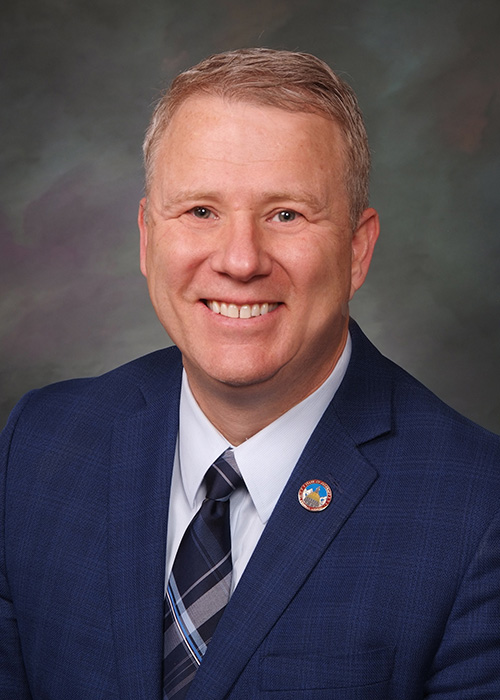
Photo of Chris Kolker
D Colorado Senate · District 16

Sen. Chris Kolker

Compare
Total votes
4,873
all sessions
Attendance
91%
421 missed
Near the chamber average
With party
98%
of cast votes
Near the chamber average
Bipartisan score
1%
crosses aisle rarely
Near the chamber average
Sponsored
445
bills & resolutions
Near the chamber average
Committees
4
assignments
445 bills and resolutions

Sponsored bills

Total
445
Primary
136
Co-sponsor
309
This page
445
matching current filters
Co-sponsor HB 1431
Signed into law · Colorado House · Co-sponsor
Competency for Occupational Licensure Portability

Under existing law, an individual licensed, certified, registered, or enrolled in good standing to practice a particular profession or occupation in another state or United States territory or through the federal government is eligible to apply for and receive a license, certification, registration, or enrollment in that profession or occupation in Colorado (accreditation) if the individual meets specific criteria. The act adds an individual licensed, certified, registered, or enrolled in good standing to practice a particular profession or occupation in another country to those individuals eligible for accreditation if the individual meets specific criteria.(Note: This summary applies to this bill as enacted.)

Signed into law Jun 4, 2026 1 co-sponsor
Co-sponsor HB 1363
Signed into law · Colorado House · Co-sponsor
Temporarily Reduce General Fund Reserve

Under current law, the general fund reserve requirement is equal to 15% of the amount appropriated for expenditure from the general fund for that fiscal year minus:The difference between $100,000,000 and the proceeds of the sale of insurance premium and corporate tax credits that are credited to the health insurance affordability cash fund; andUnless money held in an escrow account in connection with the university of northern Colorado's college of osteopathic medicine is released, an additional $41,250,000.     The act lowers the reserve requirement to 13% for state fiscal years 2025-26 and 2026-27 and then raises it back to 15% for state fiscal years 2027-28 and later.(Note: This summary applies to this bill as enacted.)

Signed into law Jun 4, 2026 1 co-sponsor
Primary HB 1420
Signed into law · Colorado House · Lead sponsor
Wind Energy Facilities Light-Mitigating Technology

In 2022, the general assembly enacted Senate Bill 22-110, concerning a requirement that a wind-powered energy generation facility be equipped with light mitigating technology (technology), to require an owner or operator of a new wind-powered energy generation facility (facility) to install technology at the facility and to obtain federal aviation administration (FAA) approval before installing the technology. An owner or operator of a facility can request from the governing body of the local government in which the facility is located an extension of up to 24 months to install the technology.     The act requires the owner or operator of a facility to also obtain federal communications commission (FCC) approval for installation of the technology and requires that a governing body of a local government grant an owner or operator of a facility an extension of time to install the technology if FAA, FCC, or other federal agency approval is delayed. The act also requires that an extension of time granted by the governing body of a local government is at least 24 months in duration.(Note: This summary applies to this bill as enacted.)

Signed into law Jun 4, 2026 0 co-sponsors
Co-sponsor HB 1414
Signed into law · Colorado House · Co-sponsor
Medical Record Requests

The act caps at $400 the amount that a health-care entity or health-care provider may charge for a record request made by a patient's attorney or the attorney of the patient's personal representative pursuant to an authorization in compliance with the federal 'Health Insurance Portability and Accountability Act of 1996', a valid subpoena, or a valid court order, if the requested record exceeds 664 pages. The health-care entity or health-care provider may charge a reasonable fee above the cap if the record request requires the health-care facility or health-care provider to segregate, withhold, or redact protected health information in order to comply with applicable law or the scope or limitations of the authorization in compliance with the federal 'Health Insurance Portability and Accountability Act of 1996', a valid subpoena, or a valid court order.     Beginning January 1, 2028, and every even-numbered year thereafter, the act requires the $400 limit to be adjusted for inflation.     The act requires the requested medical records to be delivered in electronic format if the requestor requests electronic format, the original records are stored in electronic format, and the records are readily producible in electronic format.     The act requires the health-care facility or health-care provider to provide the requestor with an invoice for the records provided in response to the record request within 30 days of receiving the request, and the health-care facility or health-care provider must provide the records upon payment of the invoice.     If the health-care facility or health-care provider is unable to comply with the request for records within 30 days after the request, the health-care facility or health-care provider must send written notice of a 30-day extension to the requestor. The health-care facility or health-care provider must provide the records to the requestor at no cost if the records were not provided within 30 days or without written notice of an extension, unless the delay is due to a force majeure event. In the case of a force majeure event, the health-care facility or health-care provider must provide written notice to the requestor within 5 business days of becoming aware of the force majeure event. The 30-day time frame to respond to a request for records commences upon resolution of the force majeure event.(Note: This summary applies to this bill as enacted.)

Signed into law Jun 4, 2026 1 co-sponsor
Co-sponsor HB 1417
Signed into law · Colorado House · Co-sponsor
Colorado Anti-Discrimination Act Testing Entities

Current law requires a testing entity to provide accommodations for an individual with a disability who is taking an exam for professional licensing. The current definition of 'testing entity' includes a private entity or a state or local governmental entity offering such an exam and having control over testing accommodation decisions.     The act changes the definition of 'testing entity' to include any person, business, or state or local government agency that offers an examination or course related to an application, license, certification, or credential for secondary or postsecondary education, professional, or trade purposes. The act further requires a testing entity to offer the exam or course in a place and manner that is accessible to an individual with a disability or offer an alternative accessible arrangement in order to accommodate an individual with a disability who has met the requirements to receive the accommodation.(Note: This summary applies to this bill as enacted.)

Signed into law Jun 4, 2026 1 co-sponsor
Co-sponsor HB 1250
Signed into law · Colorado House · Co-sponsor
Procedures Related to Civil Asset Forfeiture

The act clarifies an existing requirement for the criminal conviction of a property owner by requiring that one or more criminal charges be brought as a prerequisite to any nuisance abatement or forfeiture proceeding.     Existing law provides an exception to the conviction requirement for noninnocent owners who are not subject to criminal charges that no criminal conviction is necessary of the nonowner criminal defendant if the plaintiff proves its case by clear and convincing evidence that the property subject to the forfeiture proceeding is traceable proceeds of the charged offense or related criminal activity. The act clarifies this exception to first require a conviction of the nonowner criminal defendant before the noninnocent owner's property may be forfeited, while retaining other various exceptions that allow forfeiture actions to proceed against the interest of a claimant.     The act establishes a right for indigent civil asset forfeiture defendants to access forfeiture defense counsel and creates a procedure for the appointment of forfeiture defense counsel in nuisance abatement and forfeiture proceedings. The state court administrator shall enter into a contract for services with a private contractor who regularly provides legal services for indigent clients or litigants to provide a legal defense to a civil asset forfeiture proceeding. The private contractor is subject to certain reporting requirements.     The act creates a forfeiture defense counsel fund (fund) to pay for contracted forfeiture defense counsel who are authorized to represent persons against whom a nuisance abatement or forfeiture proceeding has been filed in connection with criminal charges. The fund is capped at $500,000, and starting in state fiscal year 2027-28, no general fund money is allowed to finance the fund. The balance of the fund over $500,000 is credited to the law enforcement community services grant program fund. The act transfers any unexpended and unencumbered money from the law enforcement community services grant program fund to the forfeiture counsel defense fund.     The act alters the disposition of property and proceeds ordered forfeited in a nuisance abatement or forfeiture action. Currently, forfeited property and proceeds are applied first toward restitution and cost recovery for a list of stakeholders, and of the remainder, 50% is granted to the local governmental body with authority over the seizing agency, 25% is granted to the local behavioral health administrative services organization, and 25% is granted to the law enforcement community services grant program fund. The act amends the disposition of the remainder so that 50% is granted to the local governmental body with authority over the seizing agency, 25% is granted to the fund, and 25% is granted to the local behavioral health administrative services organization.     The act appropriates $556,750 to the judicial department from the fund for civil asset forfeiture defense contracting and $55,000 to the department of local affairs from the fund for civil asset forfeiture portal administration.(Note: This summary applies to this bill as enacted.)

Signed into law Jun 4, 2026 1 co-sponsor
Co-sponsor HB 1276
Signed into law · Colorado House · Co-sponsor
Protect Safety of Individuals Who Are Immigrants

The act exempts Colorado courts' e-filing system from the requirement that users certify that they will not disclose personal identifying information obtained from the system for federal immigration enforcement.     The act authorizes a public health agency to inspect or examine a facility that houses or detains individuals who are noncitizens for purposes of civil immigration proceedings.     Under current law, the department of public health and environment is authorized to inspect facilities that house or detain individuals who are noncitizens for purposes of civil immigration proceedings. The act expands the inspection authority, including the frequency of inspections and things that are subject to inspection. A facility that refuses to allow the inspection is subject to a civil penalty. The department of public health and environment is authorized to set fees for inspections and deposit the money from the fees in the immigration facility inspection and detention cash fund, which is created in the state treasury.     The act authorizes the department of public health and environment to require facilities that house or detain individuals who are noncitizens for purposes of civil immigration proceedings to comply with requirements, including health and safety standards and reporting requirements. A facility that fails to comply is subject to a civil penalty. The act requires the department of public health and environment to submit an annual report to the attorney general concerning facilities' compliance with these new requirements and make the report publicly available on its website.     The act requires the P.O.S.T. board to establish training standards related to peace officer compliance with current laws concerning civil immigration detainers. P.O.S.T.-certified peace officers must complete the training before December 31, 2027.     The act requires the attorney general to develop and make publicly available a policy regarding current laws concerning the protection of personal identifying information.     The act appropriates $107,283 to the department of public health and environment from the immigration facility inspection and detention cash fund.(Note: This summary applies to this bill as enacted.)

Signed into law Jun 4, 2026 1 co-sponsor
Co-sponsor HB 1272
Signed into law · Colorado House · Co-sponsor
Extreme Temperatures Worker Protections

The act requires the division of labor standards and statistics (division) in the department of labor and employment (CDLE), on or before January 15, 2027, to begin collecting data concerning temperature-related injury or illness or temperature-related emergencies at worksites and to:Develop a platform on CDLE's website where users can provide information about occurrences of temperature-related injury or illness or temperature-related emergencies;Obtain from the department of public health and environment (CDPHE) data that CDPHE has collected through its syndromic surveillance program regarding occurrences of heat-related injury or illness or heat-related emergencies; andCollect similar data from the division of workers' compensation and the Center for Improving Value in Health Care.     On or before July 1, 2028, the act requires the division to develop a model temperature-related injury and illness prevention plan (TRIIPP) that thereafter must be made available on CDLE's website. Additionally, the act requires the division to review and update the model TRIIPP at least every 5 years and grants the division authority to adopt rules necessary to implement the act.     $76,651 is appropriated from the general fund to the department for use by the division.(Note: This summary applies to this bill as enacted.)

Signed into law Jun 4, 2026 1 co-sponsor
Primary HB 1287
Signed into law · Colorado House · Lead sponsor
Sunset Division of Real Estate

The act implements recommendations of the department of regulatory agencies in its sunset review and report concerning certain regulatory functions of the division of real estate (division), including the real estate commission (commission), the registration of subdivision developers, and requirements for home warranty service contracts. Specifically:Sections 1 through 5 of the act continue the division, including the commission and subdivision developers, for 11 years, until 2037, and remove home warranty service contracts from the sunset schedule;Section 6 authorizes the commission to deny a license to an applicant who has committed any of certain offenses;Section 7 extends the time that must elapse before the commission may consider an application for licensure from a person whose license was revoked from one year to 2 years. Section 7 also updates gendered language to gender-neutral language.Sections 7, 13, 14, and 25 allow the commission to communicate with licensees via electronic mail for certain purposes;Section 8 authorizes the commission to inactivate the license of a licensee who fails to comply with continuing education requirements. Section 8 also allows the division to charge a fee to each provider that submits a continuing education course.Section 9 clarifies that any licensed broker may elect to have a license issued in a previously used legal name. Section 9 also updates gendered language to gender-neutral language.Sections 10 and 11 remove language requiring the commission to serve subpoenas in the same manner as subpoenas issued by a district court and substitute language stating that subpoenas may be enforced by a court with jurisdiction;Section 12 requires the division to establish protocols addressing the security of electronic correspondence;Sections 15 through 20 and 25 update gendered language to gender-neutral language;Section 17 also changes disclosure requirements surrounding a real estate broker's affiliated business arrangement by requiring the broker to disclose the arrangement to the party the broker represents at the time of making a referral, instead of disclosing at the time the real estate purchase is fully executed; and Sections 21 through 24 allow a broker working with a buyer, seller, landlord, or tenant to disclose the buyer's, seller's, landlord's, or tenant's confidential information to the broker's employing broker or to the employing broker's designee for the purpose of proper supervision so long as the employing broker or designee does not use the confidential information to the detriment of the buyer, seller, landlord, or tenant.(Note: This summary applies to this bill as enacted.)

Signed into law Jun 4, 2026 0 co-sponsors
Co-sponsor HB 1298
Signed into law · Colorado House · Co-sponsor
Background Checks for Child Welfare Placements

The act gives county departments of human or social services and the Colorado department of human services (department) the statutory authority needed to conduct the required fingerprint-based criminal history record checks for individuals who provide out-of-home care for child-welfare-involved youth in accordance with the federal bureau of investigation's standards.     For the 2026-27 state fiscal year, the general assembly anticipates that the department will receive $350,000 in federal funds to implement the act, and $350,000 is appropriated to the office of the governor for use by the office of information technology to implement the act. The $350,000 appropriation is from reappropriated funds received from the department.(Note: This summary applies to this bill as enacted.)
Signed into law Jun 4, 2026 1 co-sponsor
Showing 1 to 10 of 445 bills
1 2 3 45 Next