

The act requires the department of health care policy and financing, in coordination with the department of human services and the department of early childhood (state departments), to contract with a single county department of human or social services to administer a centralized member integrity service to conduct fraud investigations concerning eligibility for medicaid, the children's basic health plan, the supplemental nutrition assistance program, the Colorado child care assistance program, temporary assistance for needy families, and adult financial programs (public assistance programs), and benefit overpayments. The act creates the centralized member integrity service cash fund consisting of money recouped from member fraud investigations. The centralized member integrity service must be operational and utilized on July 1, 2027. On or before February 1, 2027, the act requires the state departments to establish aligned requirements for county departments of human or social services (county departments) to comply with through a performance-based contract established between the state departments and each county department. Prior to February 1, 2027, the state departments shall draft templates of the performance-based contract with the county departments for review and comment. On or before July 1, 2027, the state departments shall enter into a performance-based contract with each county department. The performance-based contract must establish requirements for the state departments and county departments to comply with in administering public assistance programs and establish corrective action protocols that are consistently utilized by the state departments. On or before September 1, 2026, the act requires the state departments to work together, and in consultation with the county departments, to establish a continuous quality improvement process to review data reported to the state departments by the county departments. The state departments must annually submit a report to the joint budget committee that includes an update on the continuous quality improvement process and data on the impact of the continuous quality improvement process. Beginning January 2027, and monthly thereafter, the state departments must establish a single, shared online dashboard used to publish county-level and statewide performance data for the public assistance programs on a monthly basis. This data must be published on each of the state department's website's in a publicly accessible format. Beginning July 1, 2028, the state departments must oversee a streamlined public benefits delivery model that consists of up to 12 cohorts of counties in the state that will coordinate public assistance program eligibility and distribute case processing work. The state departments shall enter into performance-based contracts with each cohort for administering a new public benefits delivery model to ensure public assistance programs are administered consistently and uniformly across the state. On or before July 1, 2026, the state departments must contract with a third-party contractor to help the state departments and county departments develop and implement a plan for transitioning to the new public benefits delivery model. The act establishes an implementation work group comprised of representatives of counties, the governor's office, the state departments, and nongovernmental organizations, to work with the third-party contractor to develop and implement the transition plan. The transition plan must be delivered to the joint budget committee by January 1, 2027. The act establishes the state cross-departmental policy alignment team to align the policies of the public assistance programs to improve service delivery and outcomes for recipients of public assistance benefits. The act makes a household eligible for fuel assistance payments if the household has not received low-income energy assistance program assistance in the previous 12 months and if it is eligible for the standard utility allowance under federal law. The act requires the department of health care policy and financing to certify to the department of revenue information regarding persons who are obligated to the state for overpayment of medicaid benefits and sets forth the process for distributing money withheld from a person's tax refund owed for overpayment of benefits. To implement the act, it includes appropriations from the general fund and various cash funds to the department of health care policy and financing, the department of human services, and the department of early childhood. The act appropriates money to the office of the governor for use by the office of information technology and to the department of law from reappropriated money received by other departments. The act decreases the appropriation from the federal child care development funds made in the annual general appropriation act for the 2026-27 state fiscal year to the department of early childhood for intrastate child care assistance program redistribution by $222,598.(Note: This summary applies to this bill as enacted.)
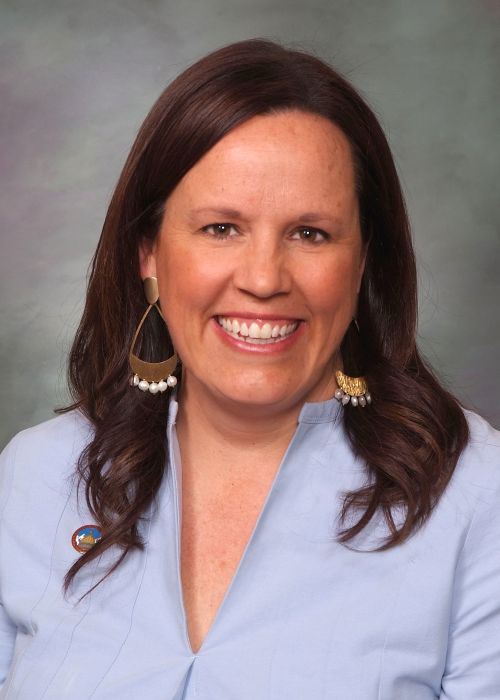
Rep. Lindsay Gilchrist
Sponsored bills
The act exempts Colorado courts' e-filing system from the requirement that users certify that they will not disclose personal identifying information obtained from the system for federal immigration enforcement. The act authorizes a public health agency to inspect or examine a facility that houses or detains individuals who are noncitizens for purposes of civil immigration proceedings. Under current law, the department of public health and environment is authorized to inspect facilities that house or detain individuals who are noncitizens for purposes of civil immigration proceedings. The act expands the inspection authority, including the frequency of inspections and things that are subject to inspection. A facility that refuses to allow the inspection is subject to a civil penalty. The department of public health and environment is authorized to set fees for inspections and deposit the money from the fees in the immigration facility inspection and detention cash fund, which is created in the state treasury. The act authorizes the department of public health and environment to require facilities that house or detain individuals who are noncitizens for purposes of civil immigration proceedings to comply with requirements, including health and safety standards and reporting requirements. A facility that fails to comply is subject to a civil penalty. The act requires the department of public health and environment to submit an annual report to the attorney general concerning facilities' compliance with these new requirements and make the report publicly available on its website. The act requires the P.O.S.T. board to establish training standards related to peace officer compliance with current laws concerning civil immigration detainers. P.O.S.T.-certified peace officers must complete the training before December 31, 2027. The act requires the attorney general to develop and make publicly available a policy regarding current laws concerning the protection of personal identifying information. The act appropriates $107,283 to the department of public health and environment from the immigration facility inspection and detention cash fund.(Note: This summary applies to this bill as enacted.)
The act gives county departments of human or social services and the Colorado department of human services (department) the statutory authority needed to conduct the required fingerprint-based criminal history record checks for individuals who provide out-of-home care for child-welfare-involved youth in accordance with the federal bureau of investigation's standards. For the 2026-27 state fiscal year, the general assembly anticipates that the department will receive $350,000 in federal funds to implement the act, and $350,000 is appropriated to the office of the governor for use by the office of information technology to implement the act. The $350,000 appropriation is from reappropriated funds received from the department.(Note: This summary applies to this bill as enacted.)
Maddy summaryThis bill designates a two-mile stretch of Colorado Highway 14 in Weld County as 'Mono & Matt Road' to honor Edwardo 'Mono' Hernandez and Matthew Garcia, two high school basketball players who died in a 2014 traffic accident. The legislation authorizes the Colorado Department of Transportation to install signs for the new name and allows the department to accept donations for this purpose while exploring a cooperative agreement with Weld County for future maintenance. By placing the names on a specific roadway, the bill creates a permanent physical tribute to the students in the location where the accident occurred.
Maddy summaryHJR 1028 is a joint resolution that declares the Colorado House of Representatives' intent to honor a $2 million investment in school funding studies by creating a multi-year plan to address their findings. The bill directs the legislature to review the recommendations from two recent studies, which found that current school funding levels are inadequate and teacher salaries are too low, and to decide which study's methodology to follow for implementation. It requires the development of a structured plan that includes revenue triggers to phase in changes aimed at improving school funding equity and teacher compensation.
Maddy summaryHR 1007 is a commemorative resolution honoring Colorado's 150th anniversary of statehood in 2026. The bill directly affects the people of Colorado and various government officials by formally recognizing the state's history, culture, and achievements. Its key provisions call on citizens to celebrate this milestone with gratitude and dedication to liberty while committing to preserve natural resources, promote civic education, and strengthen infrastructure. The resolution does not create new laws or funding but serves as a symbolic acknowledgment of the state's legacy and future goals.
Maddy summaryThis bill is a resolution that formally honors Colorado law enforcement officers for their service and sacrifices. It expresses gratitude for their role in protecting communities and encourages residents to engage with police to build trust. The measure does not create new laws or funding but serves as a public acknowledgment of officers' work and challenges.
The act creates a statutory cause of action for a person who has their federal constitutional rights violated by another person who, acting under color of law, is participating in civil immigration enforcement. A person who violates the United States constitution while participating in civil immigration enforcement and whose conduct was the proximate cause of violating another person's constitutional rights is liable to the person whose rights are violated for legal or equitable relief or any other appropriate relief. The action must be commenced within 2 years after the cause of action accrues. The act appropriates $125,604 to the department of law from the legal services cash fund to provide legal services for the department of personnel.(Note: This summary applies to this bill as enacted.)
No later than July 1, 2026, the department of health care policy and financing (HCPF) shall convene a steering committee (steering committee) to support the transition of services provided in qualified residential treatment programs (QRTP) and psychiatric residential treatment facilities (PRTF) to the managed care system for members in the care and custody of a county department of human or social services (county department). No later than April 1, 2027, HCPF, in collaboration with the steering committee, shall develop policies and recommendations to support the transition of QRTP and PRTF to the managed care system for members in the care and custody of a county department. No later than July 1, 2027, HCPF shall implement or initiate the transition of services provided in QRTP and PRTF to the managed care system for members in the care and custody of a county department according to the policies and recommendations developed by HCPF in collaboration with the steering committee. HCPF shall submit quarterly reports to the joint budget committee with information about the steering committee's monthly meetings.(Note: This summary applies to this bill as enacted.)
The act relocates in statute the disability support fund (fund), which finances the work of the Colorado disability opportunity office (office). The fund receives revenue from fees paid for license plates in a retired style and from the sale of unique vehicle registration numbers. The act makes the office responsible for administering the sale of these unique vehicle registration numbers, which was previously a duty of the Colorado disability funding committee (committee) housed within the office. The act repeals the committee on July 1, 2027. The fund is subject to annual appropriation to support the office and, for state fiscal year 2026-27 only, the fund is also subject to annual appropriation by the general assembly to the department of labor and employment (department) for vocational rehabilitation. Beginning on October 1, 2026, the $25 annual fee paid for license plates in a retired style is replaced by a one-time and annual fee of $2.50 credited to the fund and a one-time and annual donation of $22.50 remitted to the Colorado disability funding authority (authority), which is a newly created special purpose authority. The authority is governed by a board of 13 members appointed by the governor, the majority of whom are individuals with disabilities, individuals with immediate family members with disabilities, or individuals who are caregivers to a family member with a disability. In making the appointments, the governor must ensure that the authority board has members with experience in or knowledge of:Business and business management;Nonprofit entities and managing nonprofit entities;Advocacy for individuals with disabilities;The practice of medicine, with experience working with individuals with disabilities; andThe practice of law, with experience working with individuals with disabilities. The authority is required to invite nonprofit entities, independent living centers, county departments of human services, county departments of social services, and other state and county agencies to submit proposals for programs to aid individuals with disabilities in accessing disability benefits. Beginning on July 1, 2027, the authority is required to award a contract or grant to one or more of the entities that submitted program proposals. When adequate funding is available, the authority may also:Accept and review proposals to fund projects or programs that study or pilot new and innovative ideas that will lead to an improved quality of life or increased independence for individuals with disabilities; andMake grants or develop, implement, or deliver education programs concerning reserved parking that is available to an individual with a disability affecting mobility. On or before December 1, 2027, and on or before each December 1 thereafter, the authority is required to prepare and submit a financial and performance report to the joint budget committee. In addition to this annual report, the state auditor may also be required to conduct or cause to be conducted postaudits of the authority. By October 1, 2026, the state treasurer is required to issue a warrant in the amount of $523,343 from the fund to the authority. On June 30, 2026, the state treasurer is required to transfer $21 million from the fund to the general fund. For the 2026-27 state fiscal year, the act decreases by $100,000 the appropriation from the disabled parking education and enforcement fund to the department for use by the office for operating expenses. For the 2026-27 state fiscal year, $1 million is appropriated from the fund to the department for use by the division of vocational rehabilitation and independent living services. For the 2026-27 state fiscal year, $27,000 is appropriated from the fund to the department of revenue for use by the division of motor vehicles for DRIVES maintenance and support.(Note: This summary applies to this bill as enacted.)