

The act creates the access to opportunity task force (task force) to study and report on how to expand access to effective public schools to address opportunity gaps. The act requires the task force to report its findings and recommendations to the education committees of the house of representatives and the senate, the governor, the state board of education, the commissioner of education, and the department of education on or before January 1, 2027. If the first meeting of the task force is not until after July 31, 2026, then the report deadline is 5 months after the task force's first meeting. The act specifies that the task force will only conduct a study and prepare a report if the department of education receives sufficient gifts, grants, and donations.(Note: This summary applies to this bill as enacted.)
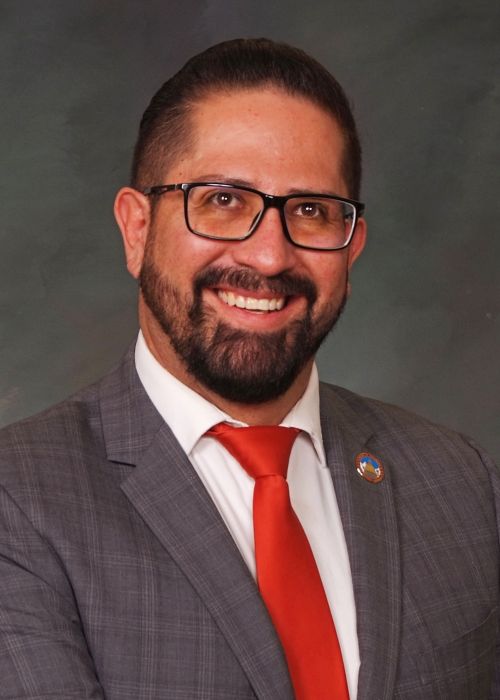
Rep. Matt Martinez
Sponsored bills
Maddy summaryThis bill updates how Colorado state colleges and universities receive performance-based funding starting in the 2027-28 fiscal year. It renames "performance funding" to "results-informed funding" and modifies the metrics used to calculate these funds, including graduation rates, student retention, and Pell-eligible student enrollment. The legislation also introduces a new definition for "co-located degree partnerships" and excludes students in these programs from certain graduation rate calculations. Additionally, the bill changes how funding components are ordered and removes requirements for sequential calculation of funding amounts.
The act exempts Colorado courts' e-filing system from the requirement that users certify that they will not disclose personal identifying information obtained from the system for federal immigration enforcement. The act authorizes a public health agency to inspect or examine a facility that houses or detains individuals who are noncitizens for purposes of civil immigration proceedings. Under current law, the department of public health and environment is authorized to inspect facilities that house or detain individuals who are noncitizens for purposes of civil immigration proceedings. The act expands the inspection authority, including the frequency of inspections and things that are subject to inspection. A facility that refuses to allow the inspection is subject to a civil penalty. The department of public health and environment is authorized to set fees for inspections and deposit the money from the fees in the immigration facility inspection and detention cash fund, which is created in the state treasury. The act authorizes the department of public health and environment to require facilities that house or detain individuals who are noncitizens for purposes of civil immigration proceedings to comply with requirements, including health and safety standards and reporting requirements. A facility that fails to comply is subject to a civil penalty. The act requires the department of public health and environment to submit an annual report to the attorney general concerning facilities' compliance with these new requirements and make the report publicly available on its website. The act requires the P.O.S.T. board to establish training standards related to peace officer compliance with current laws concerning civil immigration detainers. P.O.S.T.-certified peace officers must complete the training before December 31, 2027. The act requires the attorney general to develop and make publicly available a policy regarding current laws concerning the protection of personal identifying information. The act appropriates $107,283 to the department of public health and environment from the immigration facility inspection and detention cash fund.(Note: This summary applies to this bill as enacted.)
The act expands the 'Colorado Cottage Foods Act' (CCFA) by allowing for the sale of homemade foods that require refrigeration and foods that include meat and meat products. A producer of a food (producer) that requires time and temperature control must take a food safety course that includes food handling training concerning time and temperature control and acquire and maintain proof of course completion. A producer selling products that require time and temperature control for safety may sell one type of such food product, with the ability to offer up to 5 variations of that one type of food product. The producer must specify the individual food products that require time and temperature control for safety and provide a list of such food products to the department of public health and environment (department) or a county, district, or regional health agency (public health agency) upon request. A producer selling products under the CCFA is required to register with the department before selling. The department must issue a registration number to each producer and maintain an electronic registry of producers. A producer may earn up to $150,000 of net revenues under the CCFA each calendar year, increased from $10,000 . The department is required to adjust this cap annually for inflation. The act authorizes a public health agency that inspects or investigates homemade food products produced pursuant to the CCFA to impose a fine for a violation of the requirements of the CCFA and to recover the cost of the inspection or investigation. If a public health agency determines that, on 3 separate occasions within 12 months, a producer has misbranded food that requires time and temperature control for safety or failed to comply with requirements related to food that requires time and temperature control for safety, the producer shall not sell foods that require time and temperature control. The act creates the cottage foods cash fund (cash fund) and transfers $300,000 into the cash fund ($200,000 from the medication administration cash fund and $100,000 from the assisted living residence cash fund). The act also appropriates $119,354 to the department to implement the act.(Note: This summary applies to this bill as enacted.)
Maddy summaryThis bill designates a two-mile stretch of Colorado Highway 14 in Weld County as 'Mono & Matt Road' to honor Edwardo 'Mono' Hernandez and Matthew Garcia, two high school basketball players who died in a 2014 traffic accident. The legislation authorizes the Colorado Department of Transportation to install signs for the new name and allows the department to accept donations for this purpose while exploring a cooperative agreement with Weld County for future maintenance. By placing the names on a specific roadway, the bill creates a permanent physical tribute to the students in the location where the accident occurred.
Maddy summaryHJR 1028 is a joint resolution that declares the Colorado House of Representatives' intent to honor a $2 million investment in school funding studies by creating a multi-year plan to address their findings. The bill directs the legislature to review the recommendations from two recent studies, which found that current school funding levels are inadequate and teacher salaries are too low, and to decide which study's methodology to follow for implementation. It requires the development of a structured plan that includes revenue triggers to phase in changes aimed at improving school funding equity and teacher compensation.
Maddy summaryHR 1007 is a commemorative resolution honoring Colorado's 150th anniversary of statehood in 2026. The bill directly affects the people of Colorado and various government officials by formally recognizing the state's history, culture, and achievements. Its key provisions call on citizens to celebrate this milestone with gratitude and dedication to liberty while committing to preserve natural resources, promote civic education, and strengthen infrastructure. The resolution does not create new laws or funding but serves as a symbolic acknowledgment of the state's legacy and future goals.
The act prohibits employers from making deductions from the wages or compensation of an employee for personal protective equipment. The act also requires an employer with 500 or more employees who are engaged in the slaughter of livestock or the rendering or packaging of meat to provide its employees reasonable access to restrooms. The division of labor standards and statistics in the department of labor and employment may fine an employer who fails to provide restroom access.(Note: This summary applies to this bill as enacted.)
Maddy summaryThis bill is a resolution that formally honors Colorado law enforcement officers for their service and sacrifices. It expresses gratitude for their role in protecting communities and encourages residents to engage with police to build trust. The measure does not create new laws or funding but serves as a public acknowledgment of officers' work and challenges.
The act requires that school districts test the vision of students in pre-kindergarten, in addition to testing the vision of students in kindergarten and the first, second, third, fifth, seventh, and ninth grades. The act updates terminology by replacing the word 'sight' with the word 'vision'.(Note: This summary applies to this bill as enacted.)