

The act clarifies an existing requirement for the criminal conviction of a property owner by requiring that one or more criminal charges be brought as a prerequisite to any nuisance abatement or forfeiture proceeding. Existing law provides an exception to the conviction requirement for noninnocent owners who are not subject to criminal charges that no criminal conviction is necessary of the nonowner criminal defendant if the plaintiff proves its case by clear and convincing evidence that the property subject to the forfeiture proceeding is traceable proceeds of the charged offense or related criminal activity. The act clarifies this exception to first require a conviction of the nonowner criminal defendant before the noninnocent owner's property may be forfeited, while retaining other various exceptions that allow forfeiture actions to proceed against the interest of a claimant. The act establishes a right for indigent civil asset forfeiture defendants to access forfeiture defense counsel and creates a procedure for the appointment of forfeiture defense counsel in nuisance abatement and forfeiture proceedings. The state court administrator shall enter into a contract for services with a private contractor who regularly provides legal services for indigent clients or litigants to provide a legal defense to a civil asset forfeiture proceeding. The private contractor is subject to certain reporting requirements. The act creates a forfeiture defense counsel fund (fund) to pay for contracted forfeiture defense counsel who are authorized to represent persons against whom a nuisance abatement or forfeiture proceeding has been filed in connection with criminal charges. The fund is capped at $500,000, and starting in state fiscal year 2027-28, no general fund money is allowed to finance the fund. The balance of the fund over $500,000 is credited to the law enforcement community services grant program fund. The act transfers any unexpended and unencumbered money from the law enforcement community services grant program fund to the forfeiture counsel defense fund. The act alters the disposition of property and proceeds ordered forfeited in a nuisance abatement or forfeiture action. Currently, forfeited property and proceeds are applied first toward restitution and cost recovery for a list of stakeholders, and of the remainder, 50% is granted to the local governmental body with authority over the seizing agency, 25% is granted to the local behavioral health administrative services organization, and 25% is granted to the law enforcement community services grant program fund. The act amends the disposition of the remainder so that 50% is granted to the local governmental body with authority over the seizing agency, 25% is granted to the fund, and 25% is granted to the local behavioral health administrative services organization. The act appropriates $556,750 to the judicial department from the fund for civil asset forfeiture defense contracting and $55,000 to the department of local affairs from the fund for civil asset forfeiture portal administration.(Note: This summary applies to this bill as enacted.)
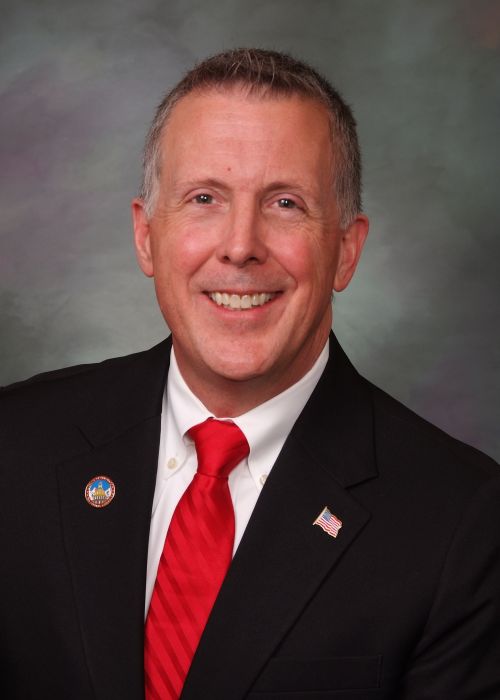
Rep. Max Brooks
Sponsored bills
The act implements recommendations of the department of regulatory agencies in its sunset review and report concerning certain regulatory functions of the division of real estate (division), including the real estate commission (commission), the registration of subdivision developers, and requirements for home warranty service contracts. Specifically:Sections 1 through 5 of the act continue the division, including the commission and subdivision developers, for 11 years, until 2037, and remove home warranty service contracts from the sunset schedule;Section 6 authorizes the commission to deny a license to an applicant who has committed any of certain offenses;Section 7 extends the time that must elapse before the commission may consider an application for licensure from a person whose license was revoked from one year to 2 years. Section 7 also updates gendered language to gender-neutral language.Sections 7, 13, 14, and 25 allow the commission to communicate with licensees via electronic mail for certain purposes;Section 8 authorizes the commission to inactivate the license of a licensee who fails to comply with continuing education requirements. Section 8 also allows the division to charge a fee to each provider that submits a continuing education course.Section 9 clarifies that any licensed broker may elect to have a license issued in a previously used legal name. Section 9 also updates gendered language to gender-neutral language.Sections 10 and 11 remove language requiring the commission to serve subpoenas in the same manner as subpoenas issued by a district court and substitute language stating that subpoenas may be enforced by a court with jurisdiction;Section 12 requires the division to establish protocols addressing the security of electronic correspondence;Sections 15 through 20 and 25 update gendered language to gender-neutral language;Section 17 also changes disclosure requirements surrounding a real estate broker's affiliated business arrangement by requiring the broker to disclose the arrangement to the party the broker represents at the time of making a referral, instead of disclosing at the time the real estate purchase is fully executed; and Sections 21 through 24 allow a broker working with a buyer, seller, landlord, or tenant to disclose the buyer's, seller's, landlord's, or tenant's confidential information to the broker's employing broker or to the employing broker's designee for the purpose of proper supervision so long as the employing broker or designee does not use the confidential information to the detriment of the buyer, seller, landlord, or tenant.(Note: This summary applies to this bill as enacted.)
Maddy summaryHR 1007 is a commemorative resolution honoring Colorado's 150th anniversary of statehood in 2026. The bill directly affects the people of Colorado and various government officials by formally recognizing the state's history, culture, and achievements. Its key provisions call on citizens to celebrate this milestone with gratitude and dedication to liberty while committing to preserve natural resources, promote civic education, and strengthen infrastructure. The resolution does not create new laws or funding but serves as a symbolic acknowledgment of the state's legacy and future goals.
Maddy summaryThis bill is a resolution that formally honors Colorado law enforcement officers for their service and sacrifices. It expresses gratitude for their role in protecting communities and encourages residents to engage with police to build trust. The measure does not create new laws or funding but serves as a public acknowledgment of officers' work and challenges.
An interchange fee is a fee established, charged, or received by a payment card network for the purpose of compensating an issuer for its involvement in an electronic payment transaction. The act states that a payment card network shall not, whether directly or indirectly:Establish, charge, or include in a fee schedule an interchange fee if:The interchange fee is or includes a percentage multiplied by the gross dollar amount of a transaction conducted with a debit card or credit card; andThe fee does not exclude from the gross dollar amount of the transaction any amount attributable to a tax on the transaction; orIncrease the rate or amount of fees that apply to the nontax portion of a transaction in an attempt to, or in a manner that would, circumvent the prohibition on interchange fees established by the act. The act exempts electronic payment transactions involving a debit card or credit card issued by a person, or agent of a person, that issues a debit card or credit card to a cardholder (issuer) that:Did not, during any point in the previous calendar year, hold consolidated worldwide banking and nonbanking assets, including assets of affiliates, other than trust assets under management, of more than $60 billion; orAs of February 1, 2026, had contracted to brand the card with the brand of a financial institution chartered or authorized to do business in this state that did not, during any point in the previous calendar year, hold consolidated worldwide banking and nonbanking assets, including assets of affiliates, other than trust assets under management, of more than $60 billion.An issuer that satisfies either of these exemption descriptions must identify to a payment card network all of the issuer's debit cards and credit cards that are used for exempted transactions. The payment card network shall not, whether directly or indirectly through an agent, contract, requirement, condition, penalty, technological specification, or inducement or otherwise:Deny such a card access to transaction processing systems; orImpose any fee increase or penalty on the issuer or on a financial institution branded on the card for any costs of upgrades or configurations to payment and processing systems that may be necessary to comply with the act with respect to such cards. If a payment card network violates the act's prohibitions, a merchant, consumer, or other person that is injured as a result of the violation may bring a civil action against the payment card network. The act sets forth the penalties to be awarded in such an action. For the 2026-27 state fiscal year and each state fiscal year thereafter, the act requires each retail business that has more than 500 employees statewide on the effective date of the act to apply any savings resulting from the act to reducing prices for consumers or investing in employee wages or benefits.(Note: This summary applies to this bill as enacted.)
The act creates the 'Colorado Mandatory Lethality Assessment Act', which requires peace officers to conduct a lethality assessment when responding to a domestic violence incident and include the completed lethality assessment in the incident report. A peace officer is not required to administer a lethality assessment if a victim is unavailable, not at the scene, incapacitated, or if circumstances otherwise make the administration of the lethality assessment impossible or impracticable. If the lethality assessment indicates that an individual is a high-risk victim, or if the lethality assessment does not indicate a victim is high-risk but a peace officer determines an individual is a high-risk victim based on the totality of the circumstances, the peace officer is required to immediately contact a community-based victim's advocate either by phone or in person and provide the high-risk victim the opportunity to speak with the advocate. The act requires the attorney general's office, in consultation with a Colorado-based coalition that advocates for survivors of domestic violence, to develop a mandatory training for peace officers to learn how to administer the lethality assessment and provide victim referrals. No later than June 1, 2027, the attorney general is required to make the training available and offer assistance to law enforcement agencies in providing the training. Beginning July 1, 2027, the act requires each law enforcement agency to ensure that each peace officer employed by the agency has completed the mandatory training; except that a law enforcement agency that has provided training on the administration of lethality assessments prior to July 1, 2027, is not required to provide additional training. Beginning January 2028, and each January thereafter, the act requires the attorney general's office to report to the general assembly certain information related to lethality assessments conducted in the previous calendar year. No later than January 31, 2030, the domestic violence fatality review board shall evaluate the effectiveness of mandatory lethality assessments and referrals to resources and submit the evaluation to the general assembly. The act does not impose criminal, administrative, or civil liability on any person for an act or omission made in good faith related to administering a lethality assessment.(Note: This summary applies to this bill as enacted.)
The act requires a volunteer lobbyist to register and file a registration statement attesting they are not being compensated. The act exempts volunteer lobbyists from registration fees. The act provides that the judicial department may designate one individual for the judicial department and one individual for each independent agency in the judicial department who may lobby on behalf of the judicial department or an independent agency in the judicial department (judicial lobbyist). A person designated by a principal executive department to be responsible for lobbying a state official or employee on behalf of the department (legislative liaison), a judicial lobbyist, or an individual who lobbies on behalf of the offices of the governor or lieutenant governor as a member of the governor's cabinet or as a personal staff employee in the offices of the governor or the lieutenant governor (governor's lobbyist) must register with the secretary of state annually. In addition to annually registering with the secretary of state, a legislative liaison, judicial lobbyist, or a governor's lobbyist must file a monthly disclosure statement with the secretary of state (disclosure statement). The act provides that a legislative liaison, judicial lobbyist, or a governor's lobbyist must indicate on the disclosure statement the bill number of any legislation for which they have lobbied or will lobby a covered official and their position regarding the legislation. The legislative liaison, judicial lobbyist, or a governor's lobbyist must update their position on the disclosure statement within 72 hours of a change in position. The act prohibits a statewide elected official or member of the general assembly from being a legislative liaison or governor's lobbyist for a period of 2 years following vacation of office. $91,000 is appropriated from the department of state cash fund to the department of state.(Note: This summary applies to this bill as enacted.)
A manufacturer of spirituous liquors (manufacturer) that seeks to serve and sell alcohol beverages acquired from wholesalers licensed in the state (wholesaler) at the manufacturer's licensed premises and any approved sales room is required to apply for a permit from the local and state licensing authorities for on-premises consumption for each location where the manufacturer will serve and sell alcohol beverages acquired from a wholesaler. Prior to issuing the permit, the local licensing authority shall provide public notice and consider the reasonable requirements of the neighborhood, zoning restrictions, and other local licensing concerns. The act includes fees that a permit applicant must pay to a local licensing authority. Upon approval from the local licensing authority, a manufacturer shall apply to the state licensing authority for a state permit. If the state permit is approved:The manufacturer must serve sandwiches and light snacks if selling and serving alcohol beverages acquired from a wholesaler; andThe proceeds from the sale of alcohol beverages acquired from wholesalers must not account for more than 50% of the manufacturer's gross annual revenue from alcohol beverage sales. The state permit is valid until the expiration of the local permit or for one year after the date of issuance of the state permit, whichever is sooner, unless the permit is inactive, suspended, or revoked. If a manufacturer does not obtain a permit from the local and state licensing authority to serve and sell alcohol beverages acquired from a wholesaler, the manufacturer may purchase and use common alcohol modifiers to combine with the manufacturer's spirituous liquors to produce cocktails for consumption on and off the sales room premises.(Note: This summary applies to this bill as enacted.)
Maddy summaryHB 1307 extends the Colorado Medical Board's existence until September 1, 2035 (replacing a prior 2026 sunset date) and implements several specific changes to medical licensing. It creates a new "administrative license" for physicians performing non-patient work (like research design or quality management) starting January 1, 2027, exempting them from continuing medical education requirements. The bill also exempts natural medicine facilitators (with a specific license) from needing a medical license to facilitate certain services, and modifies renewal rules for foreign teaching physicians and board procedures. These changes directly affect physicians seeking administrative roles, natural medicine facilitators, and the Medical Board’s operational structure.
Beginning on January 1, 2027, the act authorizes an optional collision prevention fee (fee), which is collected at the time of registration of a passenger motor vehicle, light-weight truck, motorcycle, or recreational vehicle (motor vehicle). An individual may decline to pay the fee when registering a motor vehicle, and nonpayment of the fee does not affect the individual's ability to register the motor vehicle. In connection with imposing the fee, the statewide bridge and tunnel enterprise (enterprise) within the department of transportation (department) is required to collaborate with:The department of revenue and county clerks to develop language to notify individuals about the fee, including explicit language regarding the ability to decline to pay the fee and the fact that nonpayment of the fee will not affect an individual's ability to register a motor vehicle; andThe department of revenue, the department, county clerks, the division of parks and wildlife, and other impacted stakeholders to conduct a public outreach campaign to educate the public about the fee and what benefits the fee will provide. The enterprise is required to initiate the public outreach campaign as soon as practicable and must develop and deliver customer-facing educational materials to county clerks on or before December 1, 2026.The fee amount is set at $5 and, beginning in state fiscal year 2028-29, the enterprise is allowed to adjust this fee amount upward for inflation. 75% of the revenue from the fee is credited to the newly created collision prevention fund (fund), which is continuously appropriated to the enterprise for use in the following ways:To fund wildlife safe passage projects, defined as one or more projects that reduce wildlife-vehicle collisions and improve habitat connectivity by providing wildlife road crossings;To provide matching money as required by federal grant programs relating to wildlife safe passage projects; To expend for administrative and personnel expenses related to those purposes; andTo promote the fee and fund to maximize participation in the optional fee, in collaboration with the department of revenue, impacted stakeholders, and interested organizations.In determining which wildlife safe passage projects the enterprise will undertake, the enterprise is required to:Consult with the division of parks and wildlife (division) and the Colorado wildlife and transportation alliance;Consult with the tribal government if the project is on or adjacent to tribal land;Consult with relevant local governments with jurisdiction over the area of the proposed project and any relevant local organizations engaging in work to reduce vehicle collisions;Consider studies concerning the prioritization of wildlife within the state;Consider whether the wildlife safe passage project is related to a bridge or tunnel project undertaken by the enterprise; andIn consultation with the division, consider opportunities for landowner agreements or additional conservation efforts that may be necessary to ensure the continued functionality of infrastructure associated with a proposed wildlife safe passage project. 25% of the revenue from the fee is credited to the wildlife cash fund and continuously appropriated to the division to provide services related to wildlife connectivity and wildlife crossing-related conservation efforts. The act also modifies the process for the keep Colorado wild pass fee, which is an existing optional fee paid at the time an individual registers a motor vehicle, to align with the process for the collision prevention fee by removing the presumption that an individual who declines to pay the keep Colorado wild pass fee is presumed to decline to pay that fee in subsequent years with respect to registration of the same motor vehicle. With this change, an individual must affirmatively opt out of the payment of both the keep Colorado wild pass fee and the collision prevention fee each year that the individual registers the motor vehicle. For the 2026-27 state fiscal year:$53,516 is appropriated from the DRIVES cash fund to the department of revenue for use by the division of motor vehicles; Of funds appropriated from the parks and outdoor recreation cash fund to the department of natural resources for use by the division, $778 is reappropriated to the department of revenue for use by the division of motor vehicles; and$19,940 is appropriated from the legal services cash fund, from revenue received from the department from the collision prevention fund, to the department of law to provide legal services for the department.(Note: This summary applies to this bill as enacted.)