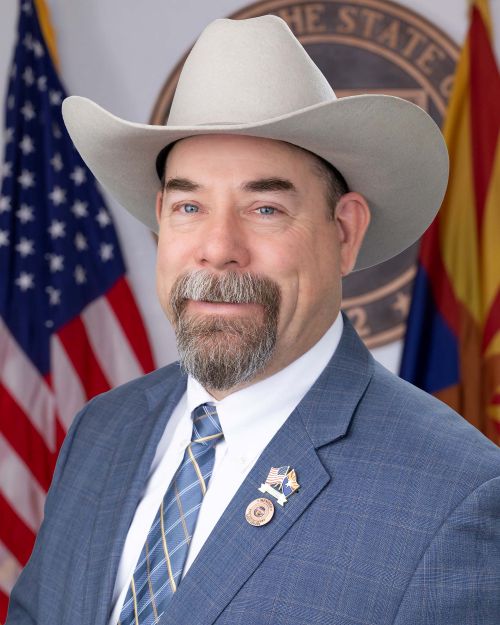
Photo of David Gowan
R Arizona Senate · District 19

Sen. David Gowan

Compare
Total votes
2,872
all sessions
Attendance
99%
29 missed
Higher than 83% of chamber peers
With party
98%
of cast votes
Higher than 80% of chamber peers
Bipartisan score
3%
crosses aisle rarely
Lower than 80% of chamber peers
Sponsored
419
bills & resolutions
Near the chamber average
Committees
3
assignments
419 bills and resolutions

Sponsored bills

Total
419
Primary
191
Co-sponsor
228
This page
419
matching current filters
Primary SB 1808
Signed into law · Arizona Senate · Lead sponsor
homeowners' associations; allied countries' flags

Maddy summarySB 1808 prohibits homeowners' associations (HOAs) from banning the display of specific flags on owner property, including the American flag, Arizona state flag, and flags from U.S. ally nations established on May 14, 1948. It also sets size limits for real estate signs (max 18x24 inches) and restricts HOAs from regulating political signs during most of the election cycle, allowing displays 71 days before primaries to 15 days after general elections. The bill requires HOAs to adopt reasonable rules for flag placement but cannot prohibit flagpoles or charge fees for display. It directly affects HOA members, unit owners, and real estate sellers within Arizona condominium communities.

Signed into law Jun 22, 2026 0 co-sponsors
Primary SB 1275
Signed into law · Arizona Senate · Lead sponsor
mandatory prison sentences; judicial discretion

Maddy summaryThis bill allows judges to impose lighter prison sentences or probation instead of mandatory prison terms for certain defendants with mental health conditions linked to military service or first responder work. It requires judges to find that imposing the mandatory sentence would cause injustice, isn't needed for public safety, and the condition relates to the defendant's military or first responder role. The law excludes cases involving death, serious injury, domestic violence, or ongoing criminal activity. Judges must state their reasoning on the record when deviating from mandatory sentences.

Signed into law Jun 22, 2026 0 co-sponsors
Co-sponsor HB 2960
Signed into law · Arizona House · Co-sponsor
veterans' court fund; grant program

Maddy summaryHB 2960 establishes a grant program to fund specialized veterans' courts in Arizona counties and municipalities. It creates a "veterans' treatment court fund" using state appropriations, providing money to local governments to set up courts that address veterans' justice-involved behavior through individualized treatment plans for issues like PTSD, substance abuse, and traumatic brain injury. The program requires grantees to report annually on participant demographics, recidivism, treatment use, and program outcomes, with the Attorney General compiling statewide data and recommendations for improvement. This directly affects veterans involved in the criminal justice system by connecting them to targeted support services rather than standard court processing.

Signed into law Jun 22, 2026 1 co-sponsor
Primary SB 1620
Signed into law · Arizona Senate · Lead sponsor
Arizona space commission; board; membership

Maddy summarySB 1620 establishes the Arizona Space Commission, governed by a 7-member board appointed by the governor, Senate President, and House Speaker. The board must include members with space industry experience (e.g., commercial aerospace, space research) or advanced degrees in space-related fields, and prioritizes local industry expertise. Key provisions require the commission to develop an annual strategic plan detailing projects, costs, and funding sources to grow Arizona’s space sector, including workforce training and infrastructure. The plan must be submitted to state leaders by December 31, 2024, and every even-numbered year thereafter, with the bill taking effect in 2026.

Signed into law Jun 22, 2026 0 co-sponsors
Primary SB 1274
Signed into law · Arizona Senate · Lead sponsor
special plate; police foundation

Maddy summarySB 1274 creates "Police Foundation Special Plates" for Arizona vehicle owners. To obtain these plates, a person must pay $32,000 to the state department for implementation. Annual registration fees of $25 apply, with $17 of that fee directly donated to the Police Foundation Special Plate Fund. The plate design is approved by the department, and the $8 administration fee covers processing and goes to the state highway fund. This program directly affects vehicle owners who choose to pay for these special plates to support the Police Foundation.

Signed into law Jun 22, 2026 0 co-sponsors
Primary SB 1271
Signed into law · Arizona Senate · Lead sponsor
businesses; crime reporting; penalty; prohibition

Maddy summaryThis bill prohibits Arizona municipalities from fining businesses based on how often they request police or emergency services, or the value of property damage they report. It specifically bans penalties tied to the frequency of emergency calls or property loss claims. Municipalities may still impose fines if a business makes malicious, knowingly false, or frivolous requests after receiving written notice of prior violations. The law directly affects businesses that report incidents and local governments that enforce such penalties.

Signed into law Jun 19, 2026 0 co-sponsors
Primary SB 1133
Signed into law · Arizona Senate · Lead sponsor
candidate financial disclosures; public officers

Maddy summarySB 1133 amends Arizona's nomination procedures for candidates seeking public office. It requires candidates to provide their actual residence address (or protected address details) and confirm residency in the district they seek to represent. The bill mandates a declaration verifying candidates' qualifications, including full payment of any monetary penalties, fines, or judgments. It also specifies strict formatting rules for ballot names, prohibiting slogans or professional titles while allowing nicknames and initials. This bill directly affects all candidates for state, county, city, town, or school district offices in Arizona.

Signed into law Jun 19, 2026 0 co-sponsors
Primary SB 1135
Signed into law · Arizona Senate · Lead sponsor
death benefits; burial costs

Maddy summaryThis bill increases burial expense coverage under workers' compensation from $10,000 to $15,000 for workers who die on the job. It directly affects surviving family members (spouses, children, dependent parents, or siblings) who were financially reliant on the deceased worker. Key provisions clarify benefit calculations: for example, surviving spouses receive 35% of the deceased's average monthly wage (plus 31.6% for children), children receive benefits until age 18 (or 22 if in school), and dependent parents may receive 25% of the wage. Funeral costs for dependents who die before the benefit period ends are capped at $800. The changes apply to Arizona workers' compensation claims following a work-related death.

Signed into law Jun 19, 2026 0 co-sponsors
Primary SB 1136
Signed into law · Arizona Senate · Lead sponsor
workers' compensation; death benefits; remarriage

Maddy summarySB 1136 amends Arizona's workers' compensation law to clarify death benefits for surviving spouses who remarry. It specifies that when a surviving spouse remarries, they receive a lump sum payment equal to two years of benefits instead of benefits simply ending. This change applies to all surviving spouses (with or without children) who lose eligibility due to remarriage, and it also updates provisions for when children become ineligible (at age 18 or 22 if in school), ensuring the surviving spouse's benefits continue as if no children existed. The bill directly affects families of workers who died on the job, particularly those where the surviving spouse remarries. The key mechanism is the mandatory lump sum payment upon remarriage, replacing the prior practice of benefit termination without compensation.

Signed into law Jun 19, 2026 0 co-sponsors
Primary SB 1366
Signed into law · Arizona Senate · Lead sponsor
commercial buildings; telecommunications services

Maddy summarySB 1366 requires commercial building owners in Arizona to provide prospective tenants with written notice of currently available telecommunications service providers at the building, before lease agreements are signed. Owners must share information they reasonably know (like existing providers with equipment on-site), but are not required to investigate or guarantee complete information. The bill explicitly states that failure to provide current information does not create a private legal claim for tenants. It also clarifies that state/local governments cannot force building owners to accept or maintain telecom facilities. The law directly affects commercial property owners and tenants regarding telecom service options.

Signed into law Jun 19, 2026 0 co-sponsors
Showing 1 to 10 of 419 bills
1 2 3 42 Next